
Church of Our Lady of the Gate of Heaven, Lisbon
On this page:
I. History
II . Description
III . Our Lady of the Gate of Heaven: worship and iconography
IV . D. João of Candia
V . Ceylon and the origins of the convent
I . HISTORY
In 1625, D. João, Prince of Candia (c. 1578-1642), acquired land in Telheiras, where he built an oratory. Around 1632, he founded a convent on the site dedicated to Our Lady of the Gate of Heaven, intended for the convalescence of Franciscan friars.
In 1642, the governance of the convent was entrusted to Friar Manuel da Esperança, Franciscan provincial minister. That same year, however, after the death of the Prince of Candia, the church underwent some difficulties, including the misappropriation of a large part of the goods donated to the convent by its founder. Friar Manuel do Sepulcro (1592-1674), the prince's former confessor, managed to recover some of the pieces that belonged to him and replace others.
Around 1700, the convent underwent a construction campaign, including the transfer of the bones of D. João of Candia to the church in 1708, where an inscription was placed over them, which has since disappeared.
The notable Brotherhood of Our Lady of the Gate of Heaven, established in the meantime, had as members illustrious figures from the Portuguese royalty and nobility. In 1752, the judges of the confraternity were King José I and Queen Mariana Vitória.
The 1755 earthquake significantly damaged the church and convent. The president of the Brotherhood’s Board, Sebastião José de Carvalho e Melo, the future Marquis of Pombal, ordered the rapid reconstruction of the buildings. The works were completed in 1768.
In 1833, in the context of the civil war, the convent was occupied by the liberal army; the friars abandoned the site, the church was looted, and the convent library was destroyed. In 1834, the convent was declared extinct.
In 1882, the government decided to sell the church, which was then in an advanced state of disrepair, but ended up handing it over to the Third Order of Saint Francis, at their request. In 1910, however, with the establishment of the Republic, the convent premises were occupied by various families, and a civil metal workshop was installed in the church.
In 1941, a campaign to restore the church began, allowing it to reopen for worship that year.
The Sri Lankan Ambassador to Brussels, Kalyananda Godade, visited the Telheiras church in 1993, expressing interest in recovering the unique connection of this monument in Portugal with the former Prince of Candia, a fact almost unknown in the local context.
In 2004, the Parish of Our Lady of the Gate of Heaven was created. And, two years later, extensive restoration work was carried out, through public and private funding, which gave the church a new visibility.
In 2017, the Mira Rio School was established on the site of the former convent, with a construction project that incorporated the remaining buildings of the old convent.
The notable Brotherhood of Our Lady of the Gate of Heaven was reactivated in 2019.
II . DESCRIPTION
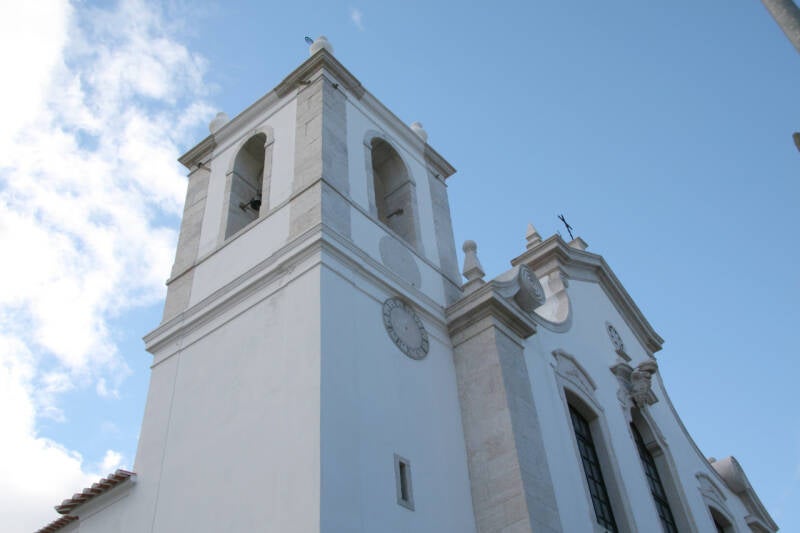
The church has a simple longitudinal plan. The bell tower, attached to the left side facade, is flanked by ashlar quoins, with a bulbous spire.
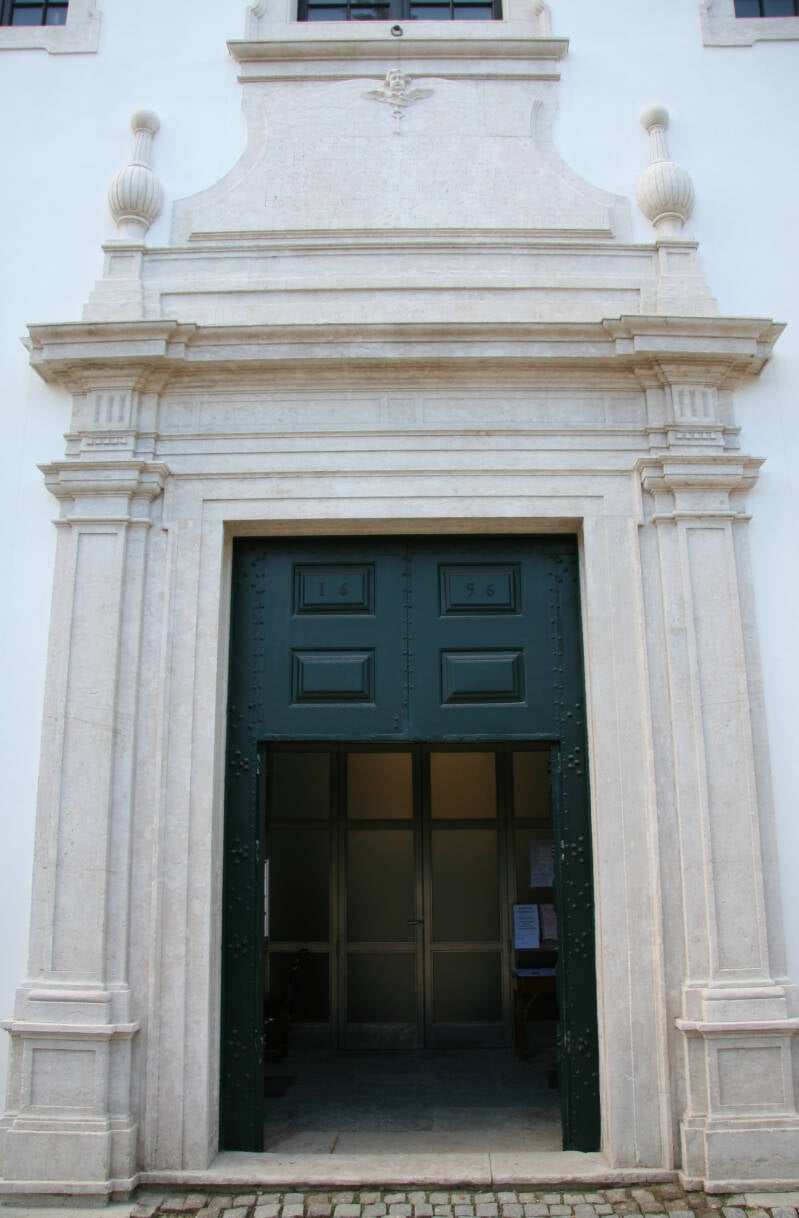
On the main façade, the double-framed limestone portal with double Tuscan pilasters stands out, topped by a small frieze with two urns. The date 1696 marks the completion of the first phase of construction.
Three large windows illuminate the choir, and above the central window is an angel with a key, alluding to the church's dedication.
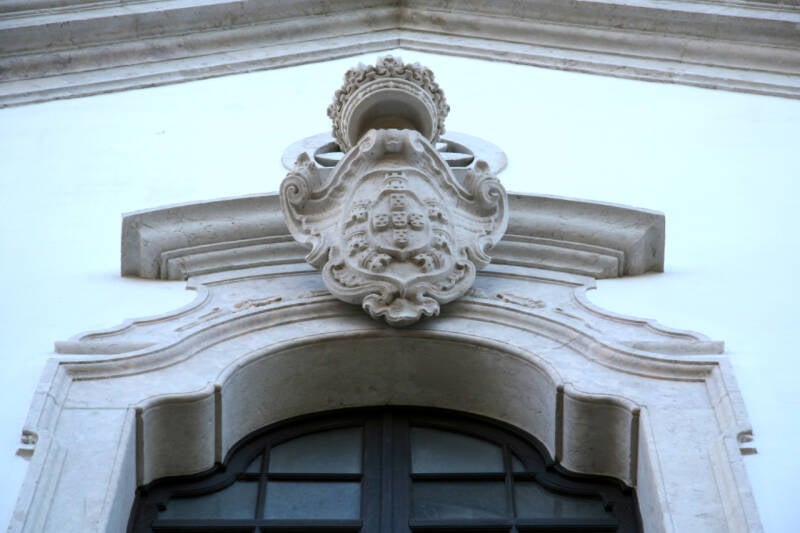
On the facade, there is a cartouche topped by the royal coat of arms, along with the historic commemorative plaque marking the reconstruction of the church after the 1755 earthquake.
HÆC TERRÆA MOTU PRÆCIPITATA DOMUS
CANDIÆ UT HANC OLIM PRINCEPS EXSTRUXIT IOSEPH
CUM REGNAT PRIMUS NUNC RENOUATA MANET
HOCQUE OEIRENSIS COMITIS TUM NOMINE FULGET
ÆTERNÆ DIGNUM POSTERITATIS OPUS
MDCCLXVIII
(This temple of Mary is called the Gate of Heaven. This house, as the Prince of Candia once built it, was destroyed by the earthquake. Now, in the reign of King Joseph I, it remains renovated. This work, worthy of eternal posterity, shines, then, with the name of the Count of Oeiras. 1768)
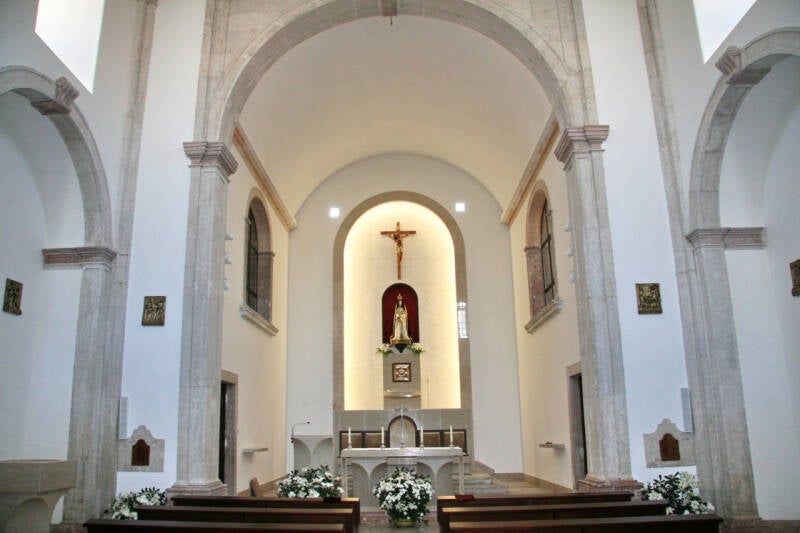
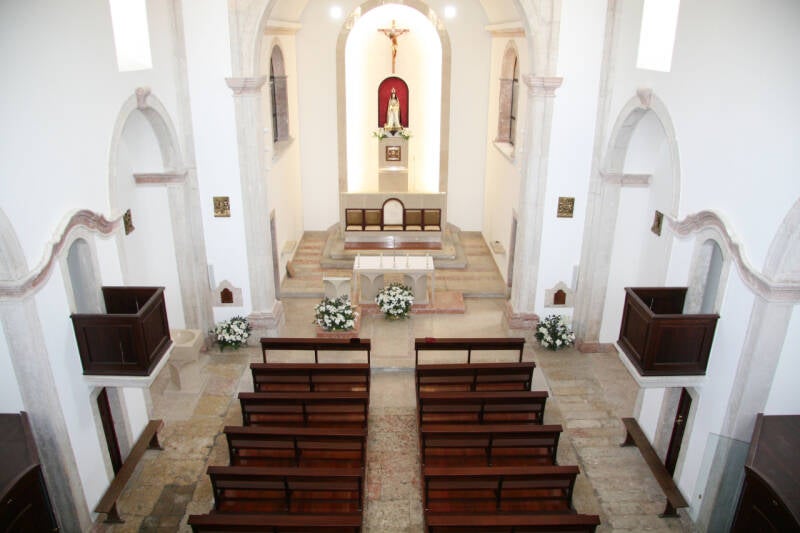
The interior, well-lit by tall windows, has a single nave, with a narrower chancel. Of the upper choir, only the segmental arch remains, supported by stone pilasters. On either side of the entrance, the red limestone holy water fonts stand out.
In the nave, the pilasters and cornices are made of pink and white limestone. The quadrangular pulpits are simple and topped by a stone frieze that extends the abaci of the adjacent chapels.
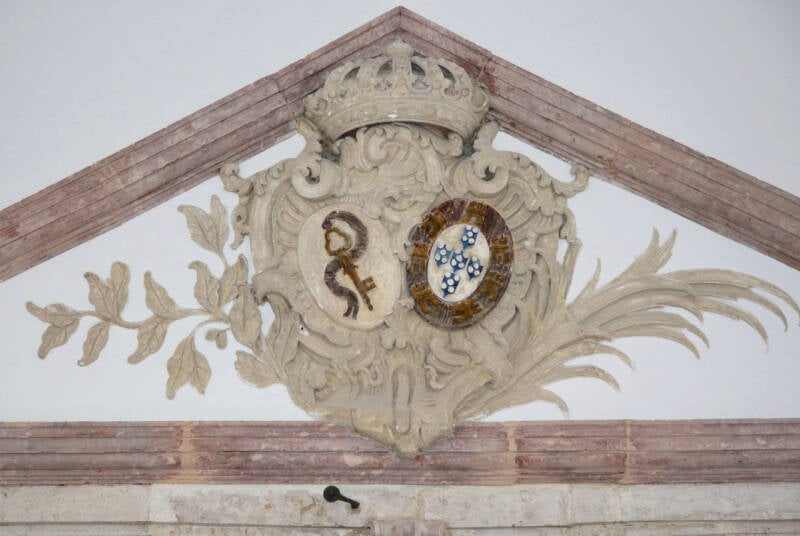
The triumphal arch, identical to that of the side chapels, ends in a triangular pediment, which dates probably from the late 18th century, with an admirable stucco composition: two medallions surmounted by the royal crown, surrounded by vegetal decoration, flanked by an oak branch and a palm. One of the medallions frames the Portuguese coat of arms; the other, the key to the Gate of Heaven.
The grilles of the old confessionals are still visible on both sides of the triumphal arch.
The chancel is presided by the venerated image of Our Lady of the Gate of Heaven.
The large side galleries that provided access to the convent are still preserved.
Of the old convent buildings, arranged in a U-shape, only the south wing remains, forming a right angle with the chancel of the church, with the original openings of the old cells; and the space of the original cloister, currently an open courtyard facing the public street.
III . Our Lady of the Gate of Heaven
The invocation of Our Lady as Gate of Heaven is very ancient. In the Christian East, the ancient icon of Portaitissa, from the 1st century, refers to an image originating from Mount Athos in Greece, which spread throughout Eastern Europe, notably Poland and Russia.
The invocation Janua cœli (Gate of Heaven) was part of the original Litany of Loreto, approved in 1587, but probably predates that.
In Portugal, the title of Our Lady as Gate of Heaven is uncommon, with the Chapel of Our Lady of the Gates of Heaven in Loulé, built around 1600, possibly the oldest place with this invocation. This was followed by the Franciscan convent in Telheiras (1632), promoted by the notable Prince of Candia.
It is a unique invocation of Our Lady, with liturgical reference in the Salve Porta of the antiphon Ave Regina Cœlorum. The title given to Mary is particularly associated with the moment of death as an intercessor for the dying.
Iconographically, the Virgin Mary is represented with the Child Jesus in her lap, on her left arm, and, in the case of the Telheiras convent, with a key in her hand, alluding to her intercession as a gateway to heaven.
The image in the church of Our Lady of the Gate of Heaven was commissioned by D. João of Candia "from a superb sculptor, whom he had heard existed in the Indies of Castile [Spanish America]", according to Friar Agostinho de Santa Maria. It was enthroned in this church in a niche and on a throne of gilded wood carving. The silver key that the Virgin held in her hand circulated among the houses of the sick in the area, being especially placed in the hands of the dying, so that Our Lady might open the gates of Heaven for them.
IV . D. JOÃO OF CANDIA (c. 1578 – 1642)
D. João, the Black Prince, was born in Candia, in the interior of the island of Ceylon (present-day Sri Lanka), around 1578. He was the son of Yamsinghe Bandara, king of Candia, who sought protection from the Portuguese after being expelled from his kingdom in 1582.
In 1588, the prince was baptized in Goa, and in 1591 he was named heir to the kingdom that his father had left to the Portuguese crown. Forced to leave the place due to the political instability reigning in Candia, D. João was taken – along with his cousin D. Filipe de Ceitavaca – to Colombo and then to Goa, always under the custody of the Franciscan friars. He lived for about fifteen years at the College of the Three Kings in Bardés, near Goa.
In 1610, he came to Portugal at his own request and under the protection of King Philip II. He initially settled in the Convent of Saint Francis in Lisbon, receiving a pension befitting his stature from the king. Around 1611, he received holy orders. Later, there is information indicating that he resided in a palace in Mouraria.
Around 1625, he acquired land in Telheiras that would become known as Quinta of the Prince. In that year he founded the Brotherhood of Our Lady of the Gate of Heaven and of the Glorious Saint John the Baptist, of which he was the first Brother and Judge. In 1626, he renounced his rights over the kingdoms of Candia, Cota, Ceitavaca and Setecorlas, in Ceylon, receiving from King Philip III more than 4000 cruzados annually in ecclesiastical pensions.
He ordered the construction of a church and an oratory in Telheiras, dedicated to Our Lady of the Gate of Heaven, intended for the convalescence of Franciscan friars due to the mild climate of the place. He donated a large number of precious liturgical objects to the church.
In 1632, he himself lived in a house adjacent to the cloister, with which he had inner communication, in order to participate in religious practices.
He died in 1642 at his home in Mouraria, and at his request, was buried in his "hermitage of Telheiras". The two stones from the Prince of Candia’s original tomb are currently in the Carmo Archaeological Museum in Lisbon.
V . Ceylon and the Origins of the Convent
The island of Ceylon, the Taprobana of antiquity – present-day Sri Lanka –, a crucial point for navigation between the two parts of the Indian Ocean, attracted the attention of Portugal from the time of Vasco da Gama's arrival in India.
The Portuguese first landed on the island in 1506, with the fleet of D. Lourenço de Almeida (c. 1480-1508). The first Mass in Ceylon was celebrated by Friar Vicente, a Franciscan.
The Franciscans played a key role in the Christianization of the island. The missionaries began their work with the encouragement of the King João Dharmapala of Kota (1541-1597), who was baptized, along with his family, in 1556. Upon his death, and having no heirs, he donated the kingdom to the Portuguese crown.
The kingdom of Candia – the kingdom of the mountains – was, however, the scene of great political turmoil. King Yamsinghe Bandara, expelled by his adversaries, sought refuge among the Portuguese. In gratitude for the protection and all the benefits received, he also left his kingdom to the crown of Portugal.
At the beginning of the 17th century, virtually all of Ceylon was under the rule of the Portuguese crown, and the Christianization of the settlements continued, particularly in the coastal regions. Only the kingdom of Candia was in permanent conflict.
Besides the Franciscans, the Jesuits, the Augustinians and the Dominicans also played an important role in the Christianization of the island: with the schools attached to their convents, they contributed greatly to the education of the people and the rapid spread of the Christian faith in the territory.
REFERENCES
- LEMOS, Fernando Afonso Andrade e, O Convento de Telheiras, Olisipo, II série, nº 12 (especial) Março 2000.
- AAVV, Monumentos e edifícios notáveis do Distrito de Lisboa, Volume V, 4º tomo, 2ª parte, Lisboa, 2000.
- MANTAS, José Quintanilha (coord.), Monografia do Lumiar, Lisboa, Junta de Freguesia do Lumiar, 2003.
- JAYASINGHE, Sagara, “The Black Prince’s Chapel: An architectural record of the Church of Our Lady of the Gate of Heaven, Telheiras, Lisbon”. Oriente. Lisboa, Fundação Oriente, 2015, vol. 23, pp. 56-77.
Adicionar comentário
Comentários