
The Way of St. James from Leon de Rosmithal
The Portuguese ways of Saint James cross the entire territory, shaping the North of Portugal in particular, not only because of the devotion to the great saint but also because of the heritage associated with him.
There were many pilgrims interested in traveling the Portuguese routes towards Santiago de Compostela. There are references in the 10th century to the obligation of supporting pilgrims, determined by the kings of León in territories that would later become Portuguese.
Throughout the 12th century, a network of inns to support travelers began to emerge. With Portugal’s independence, traces of the cult of Saint James in the territory multiplied.
Some of the first kings traveled these routes, namely King Afonso II (1220), King Sancho II (1244), Queen Saint Isabel (1325-1335), and King Manuel I (1502).
The Portuguese Way of Saint James included several alternatives: starting from Portuguese territory, namely through Alto Minho and Trás-os-Montes; or following the paths coming from Spain, through the interior.
On one of the inland routes, pilgrims entered Portugal by crossing the Douro River, through Freixo de Espada à Cinta to Torre de Moncorvo. They then proceeded to Santiago de Compostela with two options: northwards, passing through Junqueira; or westwards, via Cabeça de Mouro. It was this latter alternative that Baron de Rosmithal followed on his pilgrimage to Santiago de Compostela in 1466.
The Pilgrimage of the Lion of Rosmithal.
Baron Jaroslav Lev of Rosental and Blatna (c. 1425-1480) – Lion of Rosmithal –, an aristocrat from Bohemia (present-day Czech Republic), undertook a diplomatic tour of Europe between 1465 and 1467, in representation of his brother-in-law, King George of Podebrady of Bohemia, accompanied by a grand entourage of over forty Czech knights.
The delegation departed from Prague on November 26, 1465, traveling to Germany, the Netherlands, England, France, Spain, Portugal, and Italy. In each region they visited, Lion of Rosmithald met with monarchs and members of the European nobility.
As he approached Portuguese lands, Lion of Rosmithal began his inland pilgrimage to Santiago de Compostela.
The entourage entered Portugal in the summer of 1466. They crossed the Douro River by boat, as was customary, continued to Freixo de Espada à Cinta, passed through Torre de Moncorvo, and proceeded through the Trás-os-Montes region towards Braga. They probably used the old medieval road that connected Trás-os-Montes to the Minho province. In the city of Braga, they were received by King Afonso V, then continued to Tui towards Santiago de Compostela. They returned via Italy, arriving in Bohemia in April 1467.
The journey is documented by chroniclers who accompanied Lion of Rosmithald: the Czech nobleman Vaclav Sasek of Birkov and the merchant Gabriel Tetzel of Nuremberg (1426-1479).
The chronicle of Vaclav Sasek of Birkov (end of the 15th century), whose Czech original has been lost, had been translated into Latin in 1577 by Stanislaus Pawlowski († 1598), with the title Commentarius brevis et iucundus itineris atque peregrinationis, pietatis et religionis causa susceptae ab illustri et magnifico domino, domino Leone, libero barone de Rosmital et Blatna.
The chronicle of Lion of Rosmithal’s journey is the main historical source of reference for the Portuguese Way of Saint James in the interior of Trás-os-Montes.
In 2023, the project for the Portuguese Way of Saint James of Leão de Rosmithal was presented, promoted by the Póvoa do Lanhoso City Council. The route is approximately 240 km (150 miles) long and covers the twelve municipalities that are part of the project: Freixo de Espada à Cinta, Torre de Moncorvo, Vila Flor, Mirandela, Murça, Alijó, Vila Pouca de Aguiar, Ribeira de Pena, Cabeceiras de Basto, Vieira do Minho, Póvoa de Lanhoso and Braga.
The restored route, in addition to being a pilgrimage path, has also developed as an important means of disseminating and promoting the historical heritage of the region.
The Way of Saint James in Torre de Moncorvo
The Way of Saint James that passes through Torre de Moncorvo corresponds to one of the medieval routes of the so-called Portuguese Way. It was also probably traveled by Saint Bartholomew of the Martyrs in 1564, on his return journey from the Council of Trent.
The pilgrims, coming from Spain, entered Portuguese territory by crossing the Douro River in the Cova da Barca region – an old ferry crossing site – and continuing on to Freixo de Espada à Cinta.
In Torre de Moncorvo, travelers would arrive in the town from the East, probably following the old Street of Saint James, which retains its name.
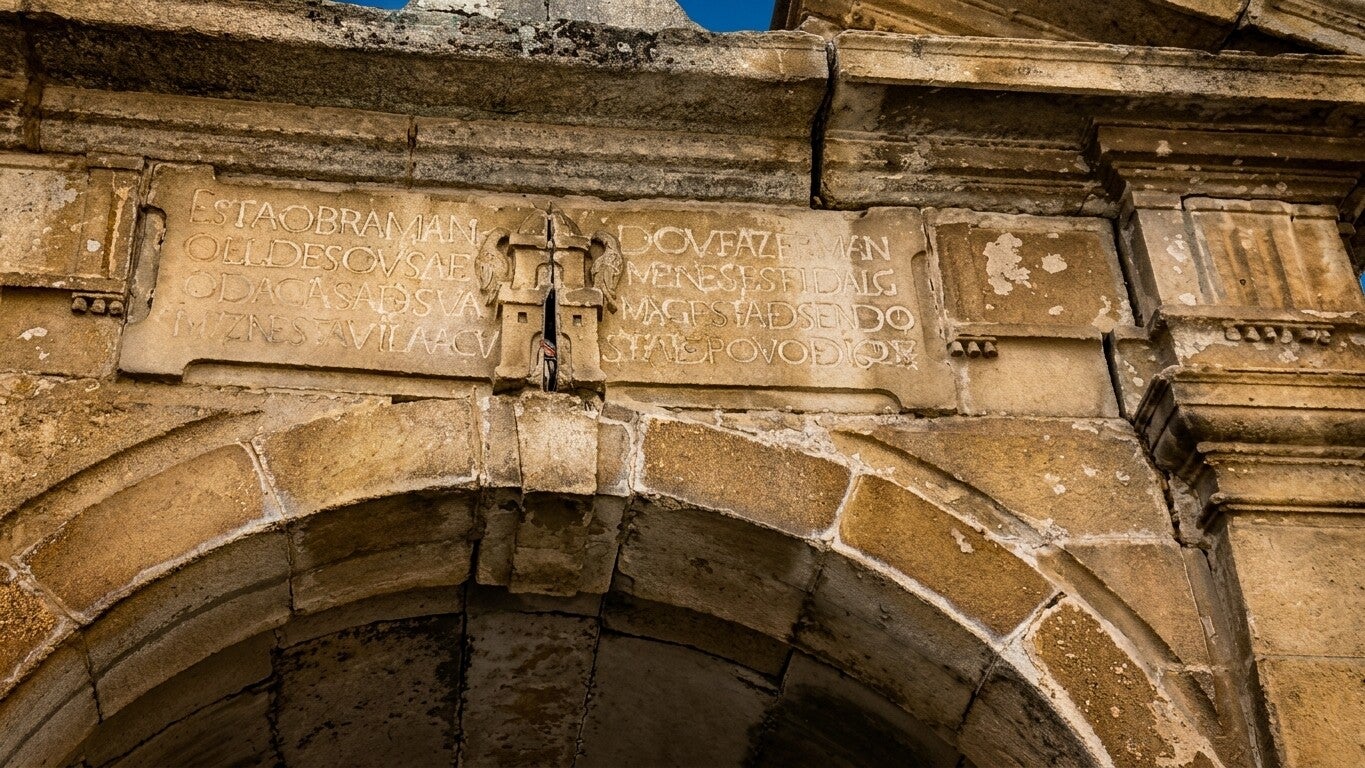
At the beginning of this street, you will find the Fountain of Saint James, a historical landmark built in the 17th century. It is a granite construction with an interior vault and a plunge fountain, protected by a railing; at the top of the pediment is an image of Saint James on horseback, now eroded by time; at the base, there is a cartouche with the municipal coat of arms and inscription:
This work was commissioned by Manuel de Sousa e Meneses, nobleman of His Majesty’s household, who was a judge in this town, paid by the people in 1628.
On that street (Saint James), there was also the church of Saint James, the first parish church of the village, already mentioned in the Inquiries of 1258. It was situated in the area of the current cemetery, having been destroyed at the end of the 19th century. The memory of a Holy Christ, an image of great devotion, placed on the "outer altar" of the church, according to a reference from 1674, remains; it is currently located on one of the side altars of the Parish Church of Our Lady of the Assumption.
One of the hostels in the village, providing support to pilgrims, was the Hospital of the Holy Spirit – the Old Hospital - established in 1491, according to an inscription still existing inside the chapel: CHAPEL OF THE HOLY SPIRIT WITH HOSPITAL FOR PASSENGERS WHO ARE POOR (...).
In the parish church of Our Lady of the Assumption, a porch was added to the south façade, according to an inscription in 1605, possibly also to accommodate pilgrims at the end of their journey in Torre de Moncorvo.
The devotion to Saint James
Saint James the Greater, a native of Galilee, was one of the Twelve Apostles. According to an ancient tradition, after Jesus’ Ascension into Heaven, he preached in Hispania, then a province of the Roman Empire, and returned to Jerusalem. He was martyred by order of Herod Agrippa around the year 44. According to tradition, his body was transferred to Galiza.
The Apostle's tomb is believed to have been discovered between 820 and 830. Alfonso II of Asturias (c. 760-842) ordered the construction of a first church, which was rebuilt and enlarged in 899 by Alfonso III of Asturias (c. 852-910).
The presence of the Apostle’s relics in the far northwest of the Peninsula motivated an extraordinary phenomenon of pilgrimage. In the 11th and 12th centuries, Santiago de Compostela was considered the third largest pilgrimage center in Christendom – after Rome and Jerusalem.
Traces of this devotion in the territory predate Portuguese independence by a considerable margin. The church of Saint James in Castelo de Neiva (built in 862) is possibly the oldest known evidence of this devotion in what is now Portuguese territory.
The devotion manifested itself in various forms, such as patron saint of churches and chapels. It particularly marked the landscape associated with the Way of Saint James, with the construction of bridges, fountains, and hostels to support pilgrims.
Saint James is iconographically represented as Apostle, Pilgrim, or Knight. This last representation is associated with his invocation as a defender of the Christian kingdoms against the Moors during the Reconquista period.
REFERENCES
- MARQUES, José, O culto de S. Tiago no Norte de Portugal, Lusitania Sacra, nº 4, Estudos de História Medieval, 1992, p. 99-148.
- AZEVEDO, Pedro Ricardo Coelho, O património jacobeu em Torre de Moncorvo: usos e interpretações, Revista Memória Rural, nº 3, 2020, pp. 292-299.
FOTOGRAPH
Conceição Bernardo
Adicionar comentário
Comentários