
Penha Chapel, Macau
On this page:
I. History
II. Description
III. Our Lady of Penha de França: history of the cult and iconography
IV. The Nau do Trato
V. The Monastery of Our Lady Star of Hope
I . HISTORY
In 1620, during the voyage of the Nau do Trato from Macau to Japan, one of the ships in the fleet, the São Bartolomeu, captained by Jorge da Silva, miraculously avoided being captured by the Dutch in the Formosa Strait.
On the 28th day of the month of July of the year 620, while making a voyage from Japan, the Pataxo Sm. Barthollomeu, whose Captain was Jorge da Silva, at five o’clock in the morning we found ourselves with a Dutch ship and shortly thereafter three more ships of our company appeared, and the said Captain Jorge da Silva immediately ordered the said Pataxo to be prepared and to put up arms (…) and because our ship was not very light, it approached us with cannon fire, (…) and seeing ourselves at this time in such distress and need, and without any remedy other than to all die, as we were already determined to burn ourselves, we sought to ask the Virgin Our Lady of Penha de França to come to our aid, and to be our Intercessor before her Blessed Son so that She might deliver us, and help us against our said enemies (1).
The crew vowed to have a chapel built in Macau dedicated to Our Lady of Penha de França, patron saint of sailors, promising as alms a portion of the merchandise revenue.
This is the origin of the Penha Chapel, donated to the Convent of the Order of Saint Augustine of Macau – an order affiliated with this invocation in Portugal.
The Chapel was built on the hill of the bastion of Our Lady of Bomparto (1) inside the fort later called Penha de França, as stated in the Act of Possession of the Hermitage by the Augustinians, drawn up on April 29, 1622. The first Mass was celebrated on that same day by Friar Estevão de Vera Cruz († 1646), prior of the convent.
The chapel benefited primarily from the alms of sailors who made their vows there. According to tradition, Portuguese ships would fire a salute as they approached Macau, and the chapel bells would ring in response; upon disembarking, the sailors would go with their families to the Chapel of Penha to give thanks and offer alms – often promised during the dangers at sea.
The Japanese route ended in 1639, but as late as 1685, Friar João das Chagas, prior of Santo Agostinho, invited the faithful to go up to the hermitage and pray for the success of the frigate São Paulo’s voyage to Japan – hoping for the reopening of trade with the Land of the Rising Sun, considered essential for the survival of Macau.
The Penha Chapel was associated with the religious upheavals of the early 18th century. Between 1707 and 1709, Spanish Dominican friars expelled from China took refuge there, in the context of the Controversies over Chinese Rites. Also in the 1780s, the vicar of Penha requested permission for the burial on the chapel grounds of residents originally from Armenia, who had a significant community in Macau.
The chapel, property of the Augustinian monastery, was handed over to the Senate in 1834, because of the decree of extinction of religious orders, with worship remaining under the responsibility of the parish priest of São Lourenço.
After being severely damaged by the typhoon of August 5, 1835, a group of about forty residents petitioned the Senate to be charged of its administration. The church was rebuilt in 1837, along with the Episcopal Palace, and entrusted to the residents in 1846, remaining under the administration and jurisdiction of the ecclesiastical authority ever since.
In 1892, the old bastion was demolished and the temple was enlarged. During this period, the feast of Our Lady of Penha, celebrated in May, was one of the main religious festivities in Macau.
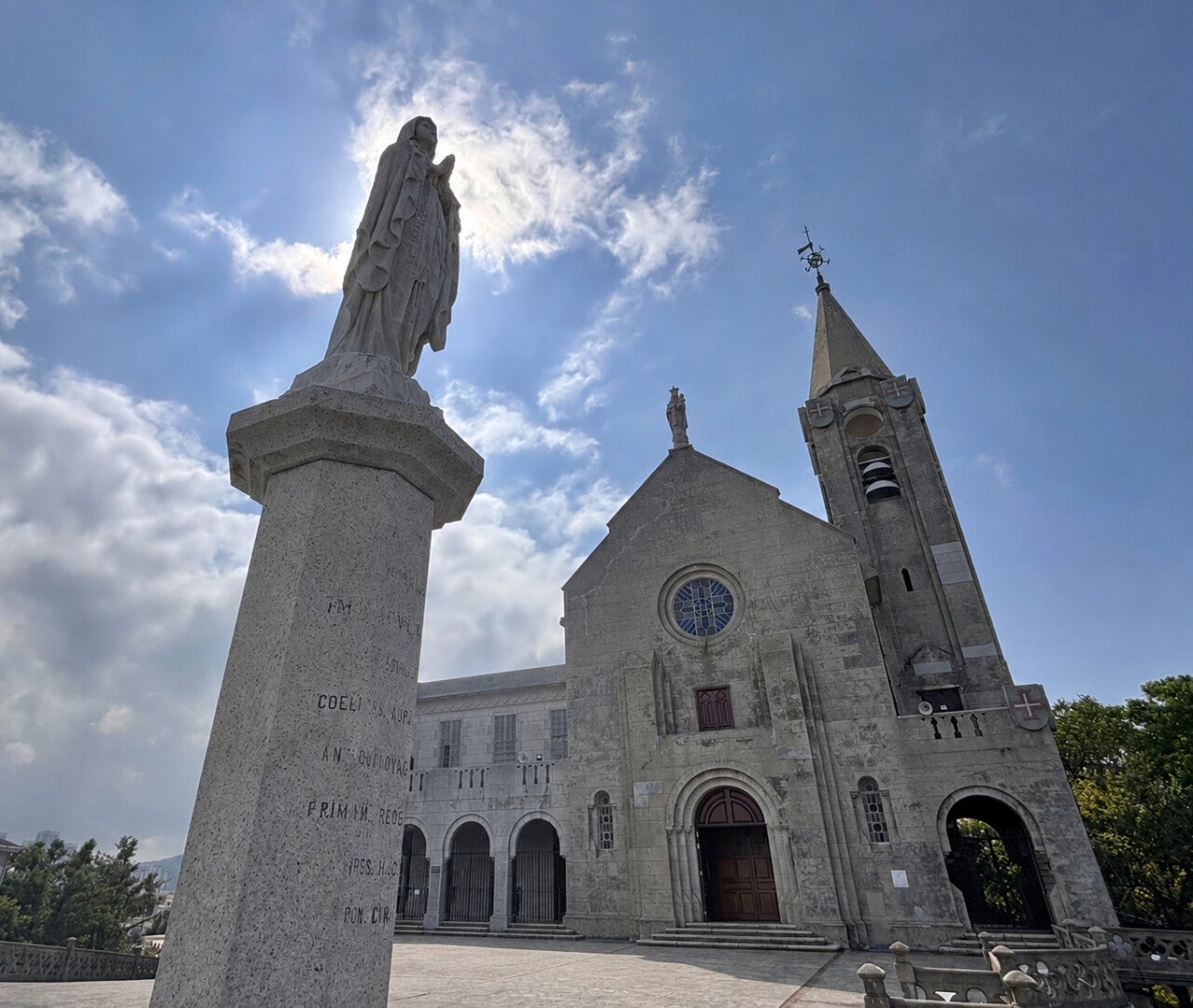
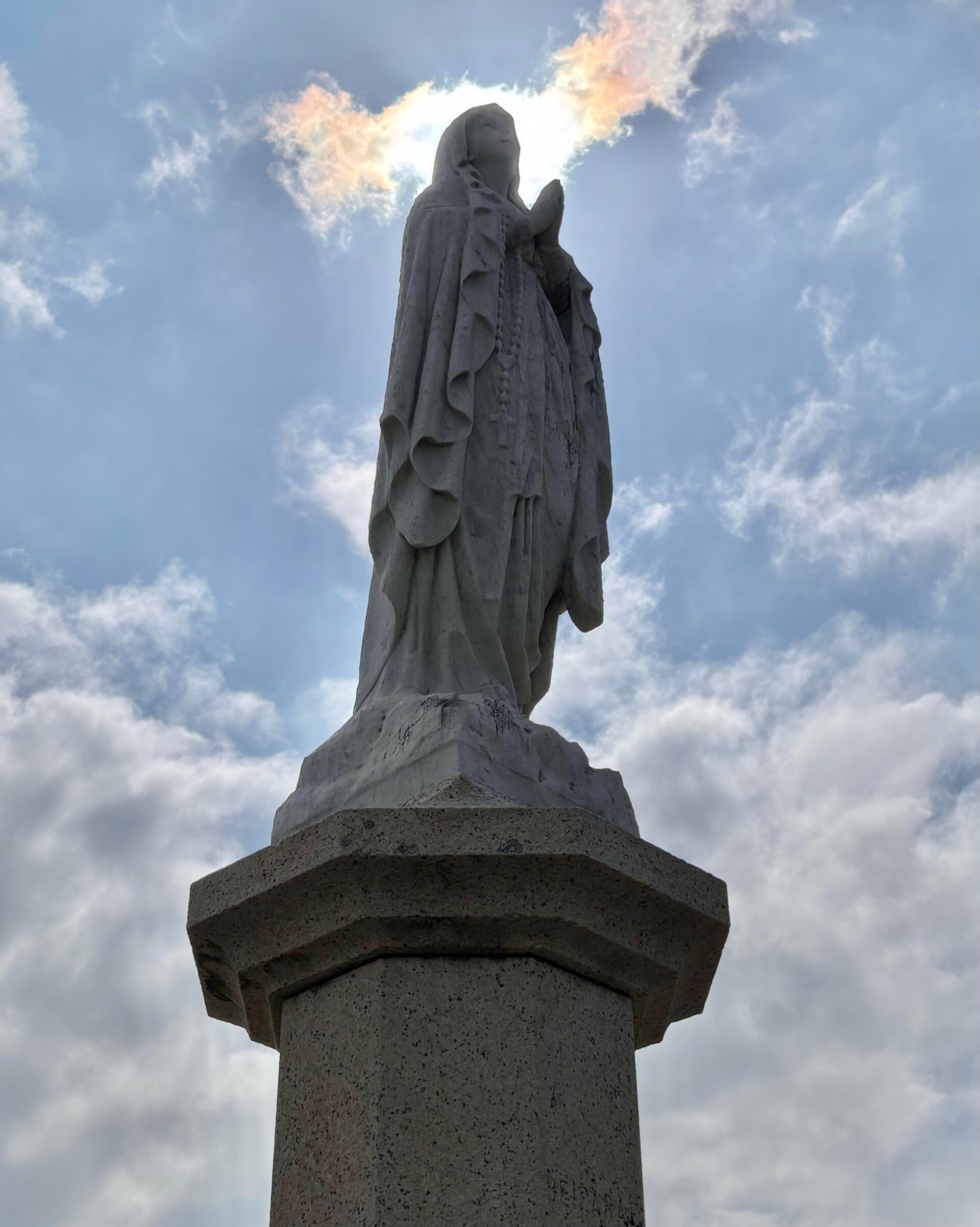
In 1909, a statue of the Immaculate Conception was erected in the churchyard on the initiative of Father António Maria Alves (1866-1944), director of the Marian Congregations and the Daughters of Mary, in commemoration of the fiftieth anniversary of the apparitions of Our Lady of Lourdes. In 1908, on land adjacent to the same churchyard, donated by José Maria de Castro and his wife, Casimira Fernandes Basto, a prominent family from Macau and Hong Kong, the Grotto of Our Lady of Lourdes was built on the initiative of Bishop João Paulino de Azevedo e Castro (1852-1918), of Macau, who was buried there – later (1923) transferred to the village of Lages do Pico in the Azores, his birthplace. Inside the grotto, a marble statue of Our Lady of Lourdes was placed, a gift from Vittória Spínola Pallavicino, a native of Genoa.
In 1929, the traditional Procession of Our Lady of Fatima began, with the route ending at the Chapel of Penha.
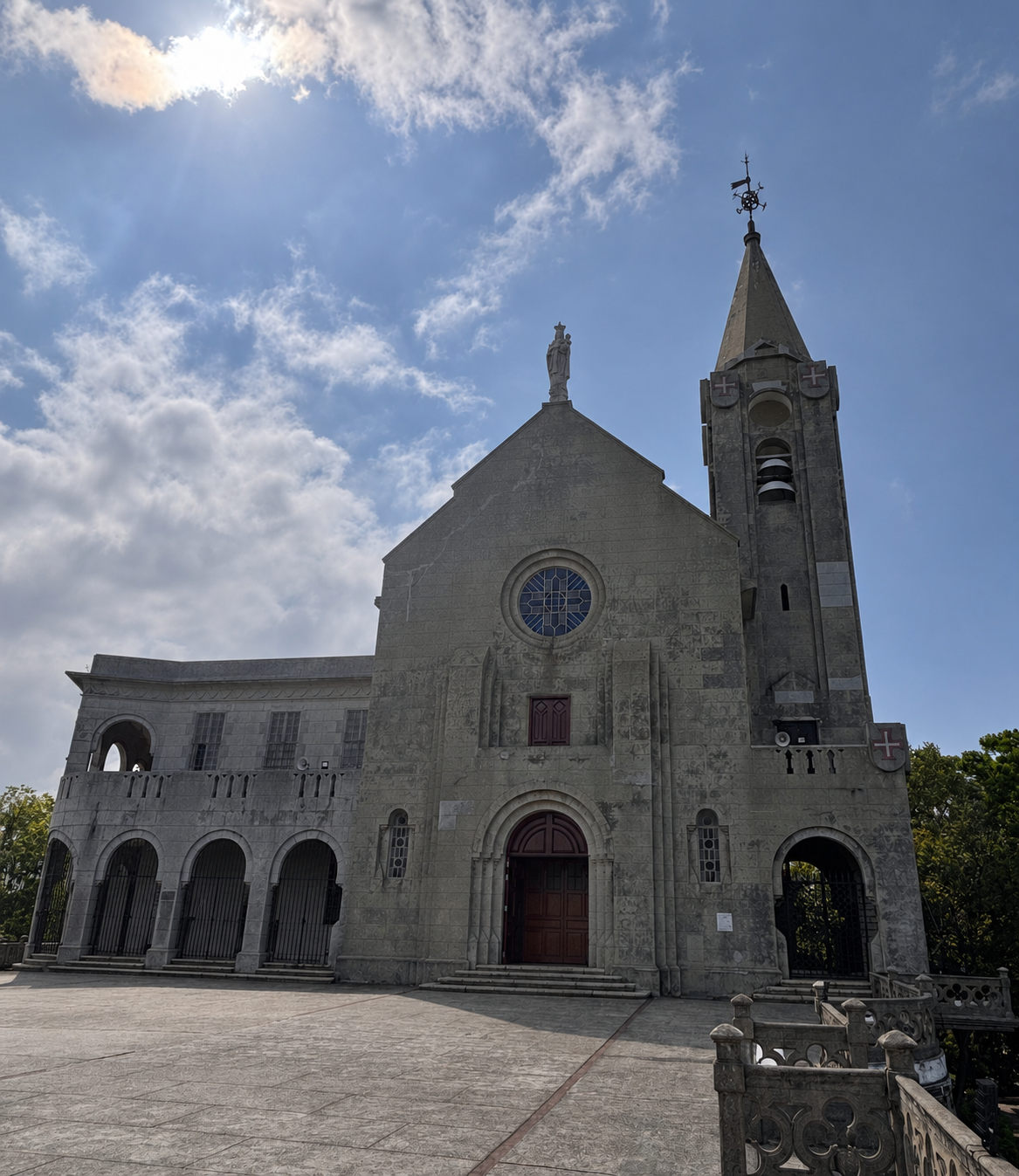
In the 1930s, the reconstruction and expansion of the chapel began at the initiative of Cardinal José da Costa Nunes (1880-1976), featuring a large bell tower and the bishop’s residence, giving rise to the monument’s current configuration. It was solemnly inaugurated on October 13, 1935.
In the 1960s, research made in the context of the defence and promotion of the artistic and historical heritage of Macau began to enhance the value of the Penha Hermitage.
The episcopal residence remained on the site until its relocation to the cathedral at the beginning of the episcopate (1976) of Bishop Arquimínio Rodrigues da Costa (1924-2016).
In 2012, the female monastery of the Cistercian Order of the Strict Observance (Trappists) was founded in the old palace.
II . DESCRIPTION
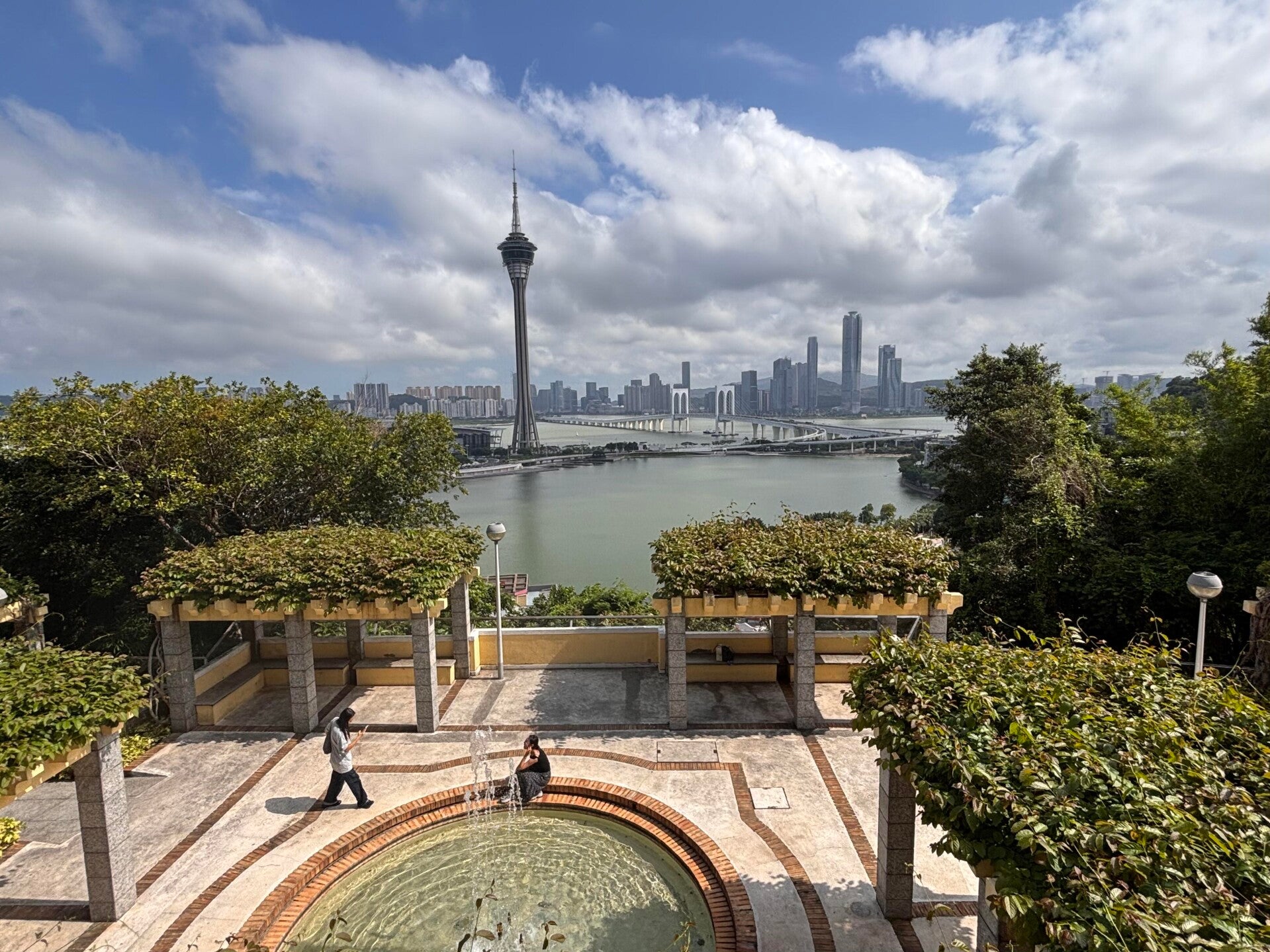
The Chapel of Our Lady of Penha is located on Penha Hill – or Bishop’s Hill –, one of the highest points in Macau, offering a beautiful panoramic view over the city and the neighbouring island of Taipa.
The temple is accessed via an ascending path, formerly walled. The entire complex is surrounded by a solid wall built in 1935.
In the courtyard preceding the church, the large statue of the Immaculate Conception stands out, erected on a column, with the inscription:
The Immaculate Conception of the Mother of God, appearing from heaven at Lourdes in the fifty-first year, returned to the city of Macau, pon. cur.
The city of Macau erected this monument to the Immaculate Mother of God on the fiftieth anniversary of her apparition in Lourdes.
On the large, neo-Gothic facade of the church, the image of Our Lady of Penha presides. The portal, with several archivolts – like medieval portals – is topped by a stained-glass oculus and flanked by large windows, also with stained glass. A notable feature is the inscription on the plaque: BUILT IN 1934-1935 TO REPLACE THE ORIGINAL CHAPEL BUILT IN 1622 AND REBUILT IN 1837.
On the right side rises the large bell tower, with the Portuguese standard of the Cross of Avis at the four angles, and a pinnacle topped with an armillary sphere.
On the left is the former episcopal residence, also built in 1935, which currently houses the monastery of Our Lady Star of Hope of the Cistercian Order of the Strict Observance (Trappists).
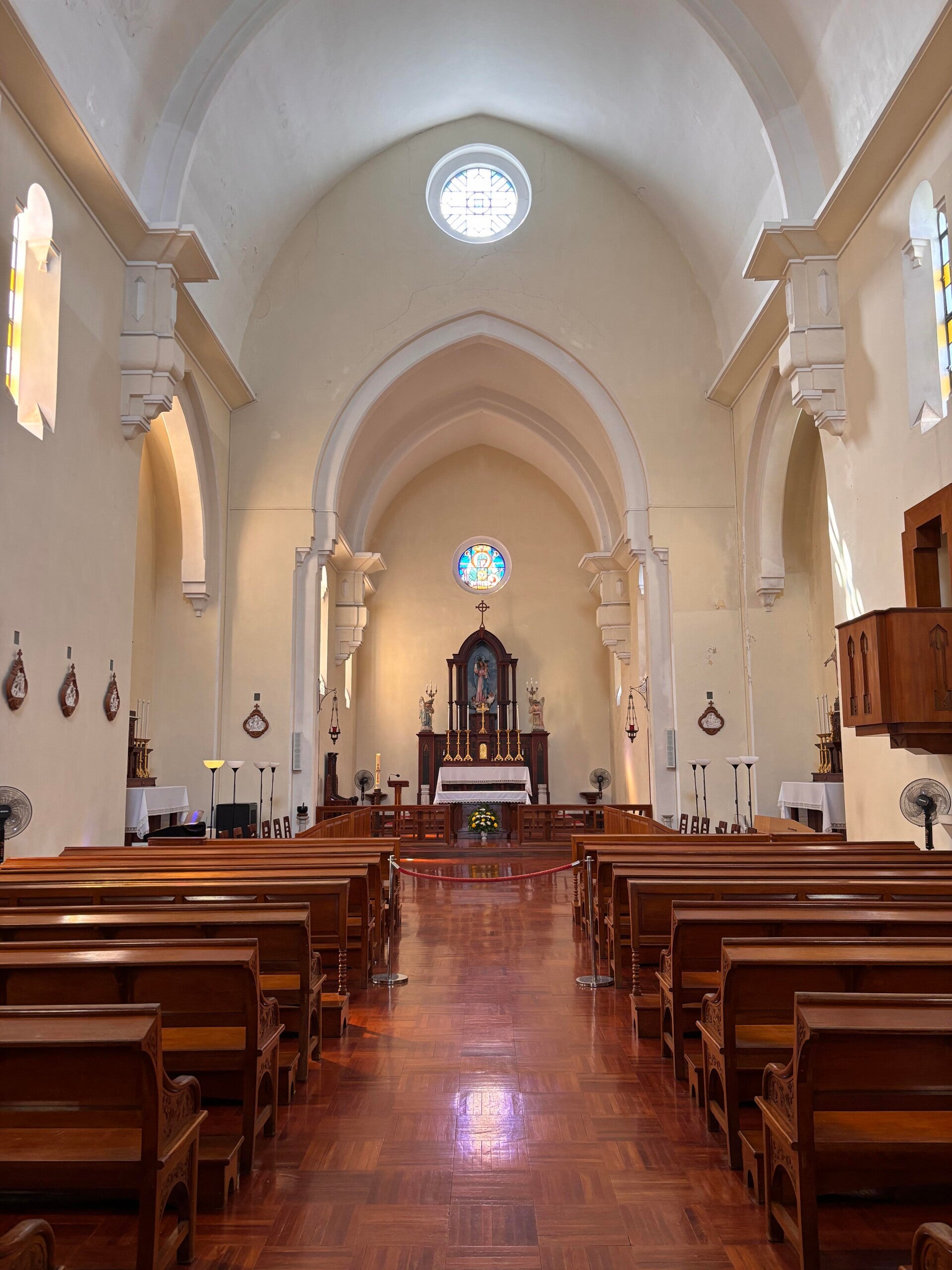
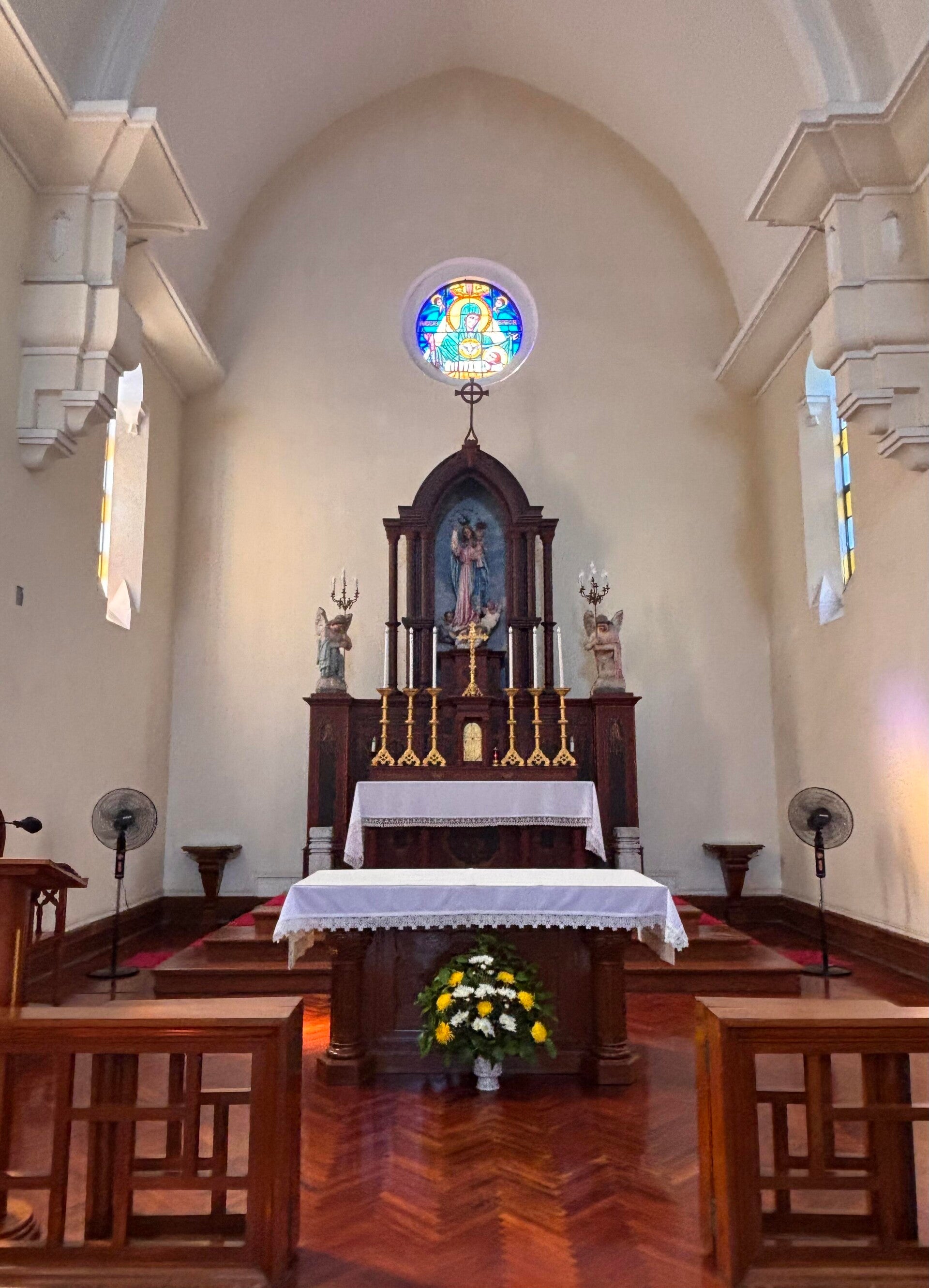
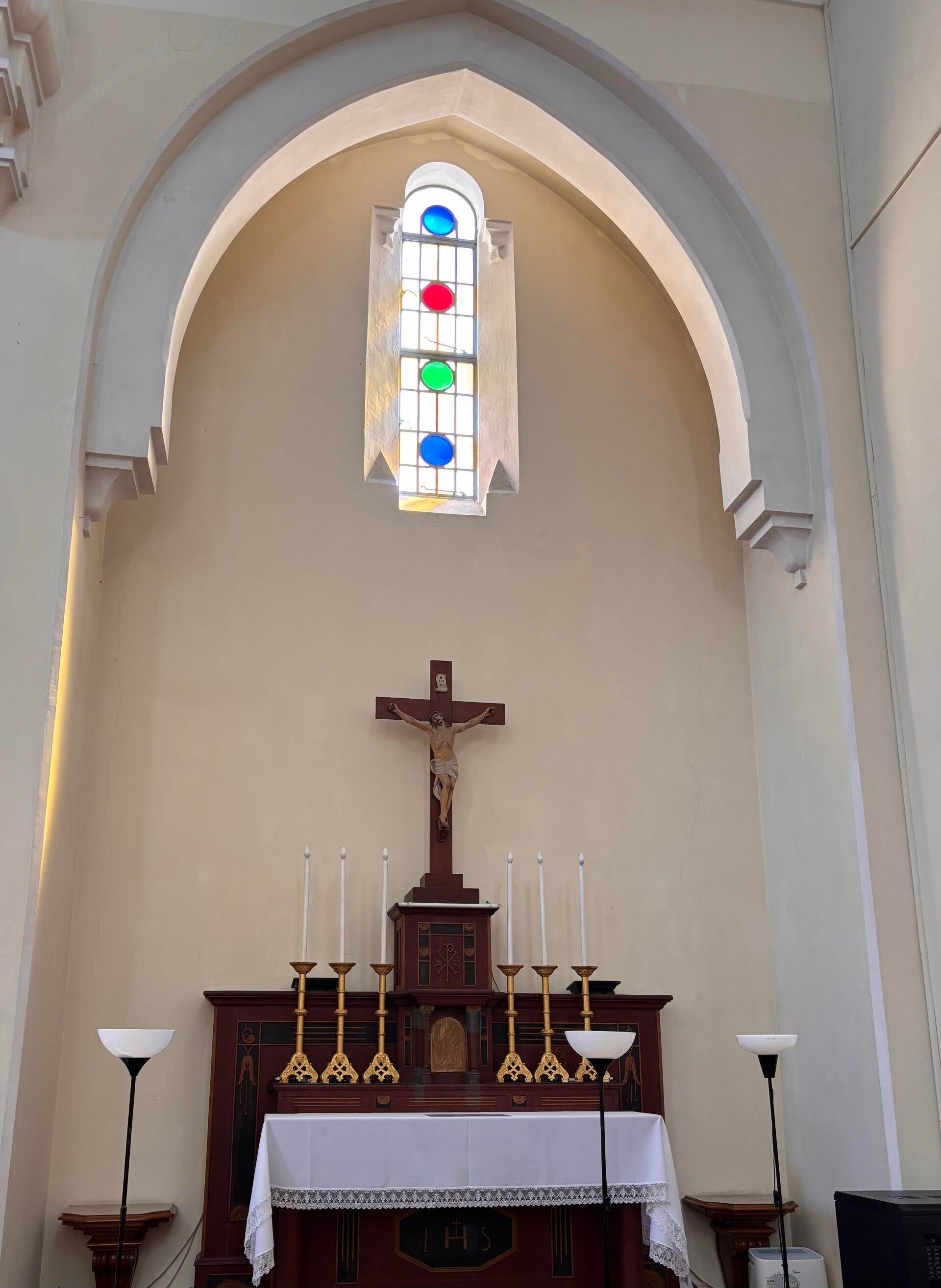
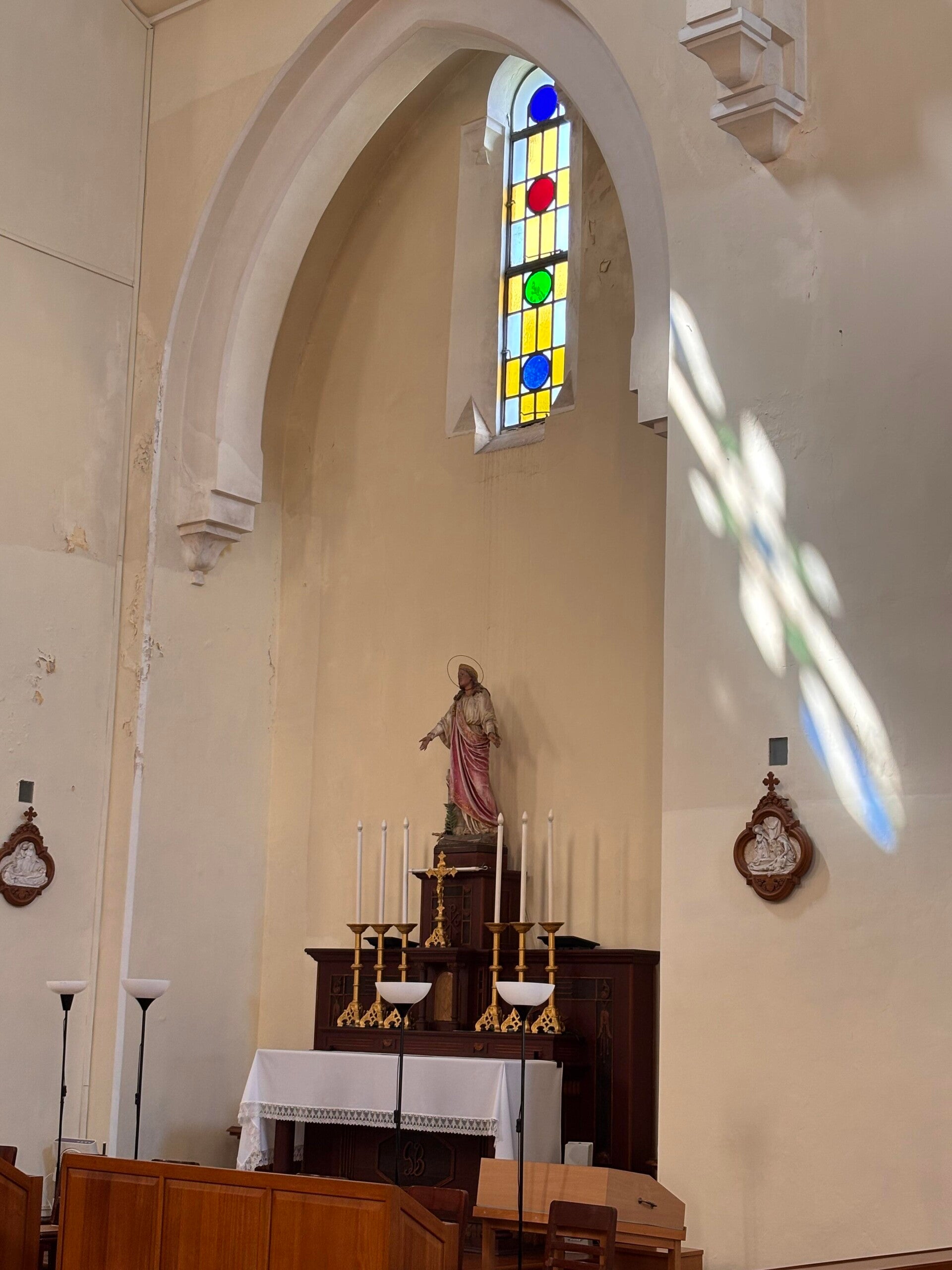
The interior is relatively simple and well-lit by light filtered through the stained glass windows.
The nave is traversed by the fourteen stations of the way of the cross, a remarkable collection of bas-reliefs.
It has two side altars dedicated to the Holy Crucified Christ and to Saint Barbara, patron saint of artillerymen, an invocation perhaps referring to the original fort.
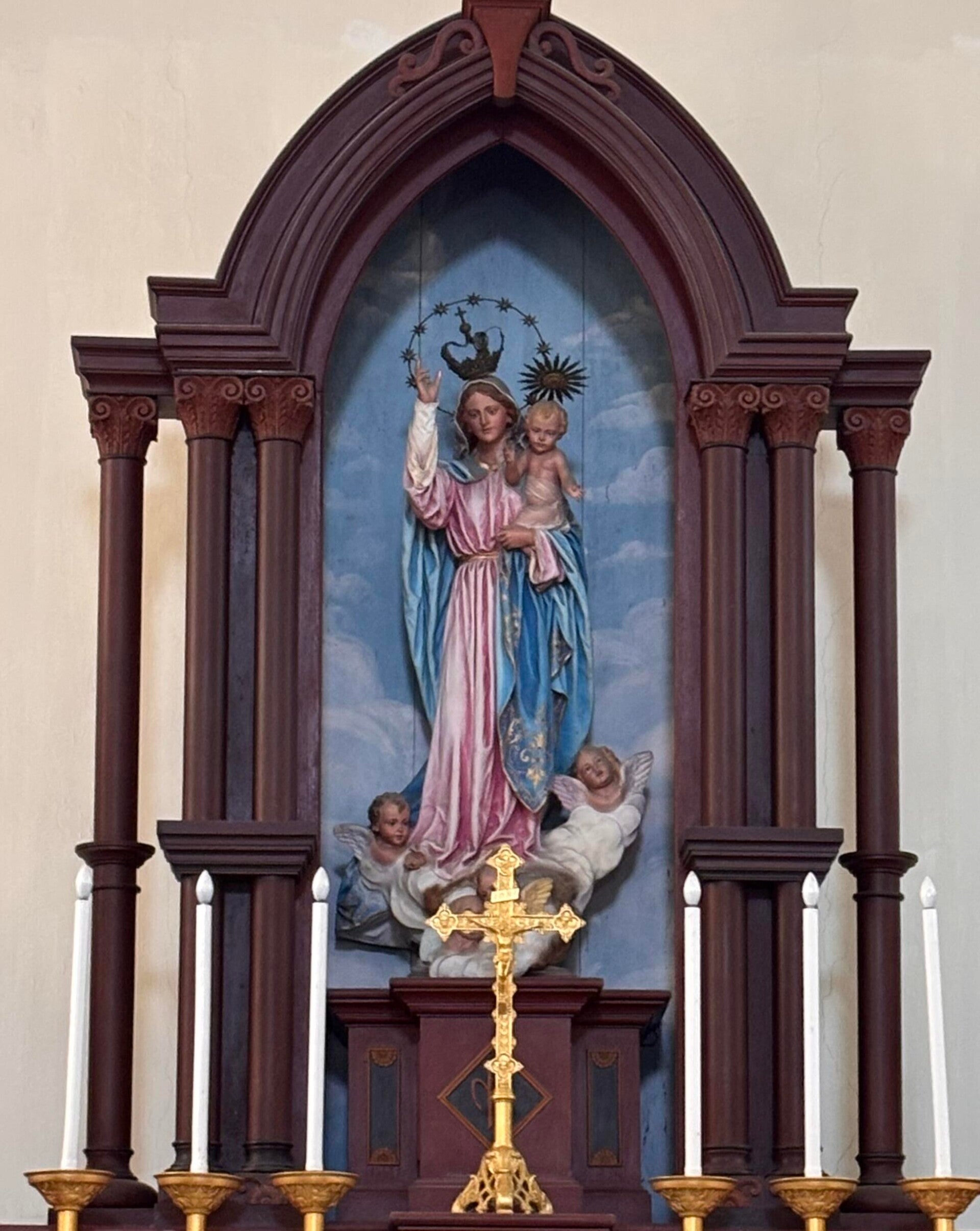
In the chancel, the image of Our Lady of Penha, greatly revered by the faithful, presides, flanked by torch-bearing angels.
On the back wall stands out the remarkable stained-glass window with the inscription ABBA PATER, with a unique representation of the Virgin Mary and the Holy Trinity.
Outside, you'll find the Grotto of Our Lady of Lourdes, a replica of Massabielle, a place of great local devotion, accessible via a wide double stone staircase.
III . OUR LADY OF PENHA DE FRANÇA: HISTORY OF THE CULT AND ICONOGRAPHY
The invocation Our Lady of Penha de França is linked to the discovery, in 1434, of an image of the Virgin Mary buried on the summit of a mountain near Ciudad Rodrigo, in the province of Salamanca, a place called Peña de Francia.
In Portugal, the devotion began with the sculptor António Simões who, in Alcácer Quibir (1578), promised Our Lady that, if he returned to his homeland, he would dedicate images of different invocations to her. Upon returning, he fulfilled his promise, giving the title of Our Lady of Penha de França to the last image. The Sanctuary of Our Lady of Penha de França in Lisbon was entrusted to the Order of the Hermits of Saint Augustine.
Popular devotion developed rapidly. From 1599 onwards, several events intensified the cult. In that year, Jerónimo Coutinho – Captain of the Armada of the India Route –, faced with the threat of plague that broke out on ships in the middle of the ocean, turned to Our Lady of Penha de França. From then on, the invocation became associated with seafarers in Portugal and in the countries of Portuguese expansion. It was common for ships to carry an image of Our Lady of Penha de França, invoked in situations of danger at sea.
In Macau, devotion intensified from 1620 onwards, when the ship São Bartolomeu, of the Japan route, was saved from attacks by a Dutch fleet through the intercession of the Patron saint of seafarers.
The crew vowed – just as they had done a few years before, on the ship of Jerónimo Coutinho, on the India route – to build a hermitage dedicated to Our Lady of Penha de França in the City of the Holy Name of God of Macau.
The chapel was handed over by the sailors to the Order of Saint Augustine, which already owned the Convent of Our Lady of Grace in Macau.
It is likely that there were ex-votos from sailors in the Penha Hermitage, like the ones in the sanctuary of Lisbon. According to Commander Jayme de Inso, there was an ex-voto dated 1792 offered to Our Lady of Penha de França of Macau with the following inscription: Lord Captain Joaquim Carneiro Machado, Brother of the Order of Augustinian Hermits, offered this Lamp to Our Lady of Penha de França of Macau Year 1792 (2).
Iconographically, Our Lady of Penha de França is usually represented with a crown, a scepter in her right hand, and the Child – also crowned – in her left arm.
The liturgical feast is celebrated on September 8th.
IV . THE NAU DO TRATO
The arrival of the Portuguese in the Land of the Rising Sun in 1543 marked the beginning of the Japan Route. Trade was very lucrative despite the inherent risks of the journey, namely frequent shipwrecks and piracy.
In 1550, an annual voyage was created that would be a monopoly of the Portuguese crown, overseen by a captain major. From 1557 onwards, Macau became a mandatory stop on the route of the Nau do Trato – the large black ship that established trade links with Japan.
Macau was an important centre for cultural exchange between the West and the East, with exclusivity on this route, one of the biggest sources of income for Macau.
By the end of the 16th century, the route was already a regular annual service. The ship would leave Goa, dock in Malacca and continue to Macau, where it would stop to await favourable monsoon conditions before proceeding to Japan.
At the beginning of the 17th century, difficulties began to arise in carrying out the journey, especially after the arrival of other European powers, namely the Dutch. In the first attack on Macau, in 1603, the Flemish seized all the merchandise that was being prepared to go to Japan. In the following years, attacks became constant along this route.
The relative ease with which the Dutch captured the large, richly laden Portuguese ships in the seas off China led to a rethinking of how goods were transported. From 1618 onwards, the practice of sending all goods on a single vessel was replaced by dividing the cargo among several ships, in an attempt to mitigate losses resulting from enemy attacks. The large carrack was replaced by lighter vessels – pataches, small ships, galleys – on the route between Macau and the port of Nagasaki. It is in this context that Captain Major Jerónimo de Macedo de Carvalho undertook the voyage of 1620 with a fleet of ships, including the patache captained by Jorge da Silva.
Trade between Macau and the Land of the Rising Sun ended definitively in 1639, bringing an end to the prestigious Japan route.
V . THE MONASTERY OF OUR LADY STAR OF HOPE
In 2009, a community of nuns from the Cistercian Order of the Strict Observance (OCSO), commonly known as Trappists, settled in the former episcopal palace of Macau.
The community was founded from the Gedono women’s monastery in Indonesia, which in turn is rooted in the Vitorchiano monastery (Italy), the mother house of several foundations in Asia.
On June 22, 2009, the first nuns departed from Gedono for Macau, beginning their monastic life in the former episcopal residence attached to the historic Hermitage of Penha, by cession of the Diocese of Macau. The canonical foundation of the monastery took place on April 15, 2012, under the invocation of Our Lady Star of Hope.
On January 26, 2026, the community was solemnly elevated to a Priory, with Mother Caterina Mazarelli elected as its first prioress.
The contemplative Order follows the Benedictine spirituality, according to the Rule of Saint Benedict, under the motto Ora et Labora – pray and work. In Macau, it is a unique reference for the population.
- Memória sobre a Ermida da Penha de França, O Macaísta Imparcial, Vol. I, Nº 33, 29 de Setembro de 1835, Macau, p. 132-134. https://purl.pt/32523/2/
- INSO, Com. Jayme de, Nossa Senhora da Penha de França na Evocação Marítima, Olisipo Nº 108, Out. 1964, p. 170.
REFERENCES
- TEIXEIRA, Manuel, The Japanese in Macao in XVIth and XVIIth Centuries, Sep. Bol. Instituto Luís de Camões 8, Macau, 1974. https://www.icm.gov.mo/rc/viewer/20017/984
- BOXER, Charles Ralph, The great ship from Amacon, Macau, Centro de Estudos Marítimos de Macau, 1988.
- SILVA, Beatriz Basto da, Cronologia da História de Macau, Macau, Direcção dos Serviços de Educação, 1992-1993.
- VALENTE, Maria Regina, Igrejas de Macau – Churches of Macau, Macau, Instituto Cultural de Macau, 1993.
- MARQUES, Oliveira (Dir.), História dos Portugueses no Extremo Oriente, Lisboa, Fundação Oriente, 1998-2003.
- MARIZ, Vera Félix, A “memória do império” ou o “império da memória” a salvaguarda do património arquitectónico português ultramarino (1930-1974), Dissertação de Doutoramento, Lisboa, Universidade de Lisboa, 2016.
- TEIXEIRA, Vítor, Capela de Nossa Senhora da Penha, O Clarim, 26 de Março de 2025. https://www.oclarim.com.mo/local/capela-de-nossa-senhora-da-penha/
SPECIAL THANKS
We would like to give a special thanks to the Community of the Monastery of Our Lady Star of Hope for all the additional information.
PHOTOGRAPHY
- Teresa J. C. Lopes da Silva
Adicionar comentário
Comentários