
Cathedral of Luanda, Angola
On this page:
I. History
II. Description
III. The Jesuits in Luanda
IV. The Most Holy Name of Jesus: cult and iconography
V. The Archdiocese of Luanda
I . HISTORY
In 1581, Paulo Dias de Novais (c. 1510-1589), the first Governor of Angola, donated to the Jesuits a plot of land in what was then known as Praça da Feira – now Largo do Palácio –, “a high, healthy, wind-swept and shaded place” (1), in the newly founded town of Luanda, for the construction of a church and its college.
Having begun in 1605/1607, the construction of the buildings took long, mainly due to a shortage of funds. In 1609, the ashes of Paulo Dias de Novais were transferred from Massangano, fulfilling his wish to be buried in this church; in 1620, the commemorations for the beatification of Saint Ignatius of Loyola and Saint Francis Xavier were held here, even though the works had not yet been completed.
The Jesuits expanded the building area through other donations and even by buying land. In 1619, Gaspar Álvares (died in 1623), a wealthy trader, made a substantial donation to boost the construction of the church and the college, and later, left a large sum of money in his will, particularly intended for the construction of a seminary.
The building of the church dedicated to the Most Holy Name of Jesus – although no records of such invocation are known – was completed in 1636. It is referred to as a “very grandiose” monument, the most impressive temple in Luanda, for its size, aesthetics and wealth of marble, paintings and altarpieces. According to the Ignatian tradition, different congregations were established there: of Our Lady of Help, of Saint Francis Xavier, of the Eleven Thousand Virgins – for students – and of Our Lady of the Rosary, a congregation which brought together slaves and freedmen.
Although it had not yet been finished, the first teachings were already taking place in the College of Jesus.
Between 1641 and 1648, the church and the college were occupied by the Dutch; the church was used as a space for “assemblies and gatherings” (1), and the college as the residence of the Flemish governor.
With the liberation of Luanda by Salvador Correia de Sá (1602-1688) on August 15th, 1648, the Jesuits once again took over the buildings. The festivities that followed centred on the Jesuit church, confirming how important it had become in a city with its most temples ruined during the Flemish rule.
1659 saw the completion of the works on the College of the Most Holy Name of Jesus. The church continued to be enriched and, in the early 18th century, the altarpieces for the chancel and side chapels were commissioned.
After the expulsion of the Jesuits in 1760, the temple was abandoned and some of its precious implements and vestments were either transferred to the church of Our Lady of the Conception – the former Cathedral of Luanda – or kept in the custody of the Capuchins in the nearby convent of Saint Anthony. An attempt was made to turn the Jesuit church into the new cathedral, however the project failed but due to its state of disrepair.
The residence of the Bishop of Luanda, also used as Episcopal Palace, was set in one zone of the former college building. The remainder of the building was quite dilapidated, the roof of the church having collapsed in 1780. In 1853, a decree created the Luanda high school seminary according to which classes would begin in the building of the former Jesuit convent, in the part still usable and not occupied by the bishop; there is also news of a primary school in an adjoining room. In 1882, the seminary was transferred to Huila and not until 1907 did it return to the premises of the old Jesuit college, where it operated until 1935. The Jesuit compound was abandoned, was later used as stables and afterwards as a workshop for Public Works.
In the mid 20th century, there was again the desire to rehabilitate the once outstanding Church of Jesus. In 1945, it was classified as a Historic Cultural Heritage Site and the restoration process began. Only the main façade and the chancel with its magnificent marble inlaid altarpiece were standing at the time.
The works began in 1957/58, under the responsibility of architect Martinho Humberto dos Reis (born in 1904), with the aim of restoring the original design of the church. The works included: the construction of the church roof and the weathervane for the church tower (that had been lost, but appeared in old drawings); the restoration of the main façade; inside, the restoration of the chancel, the side and collateral chapels, and the vestry.
The church was reopened for worship on December 22nd, 1958, in a ceremony presided over by the Archbishop Moisés Alves de Pinho (1883-1980) of Luanda. Between 1961 and 1974 it was the headquarters of the Angolan Military Chaplaincy for the religious services of the Armed Forces.
In 1975, the Church of Jesus was elevated to become the seat of the Parish of Our Lady of the Conception and finally, in 1978, it became the Cathedral of the Archdiocese of Luanda.
On October 8th, 2024, Alexandre Cardinal Nascimento (1925-2024), a personality notable for his tireless work in the service of the Church, particularly during the period of great turmoil in Angola, was also buried in a solemn ceremony.
II . DESCRIPTION
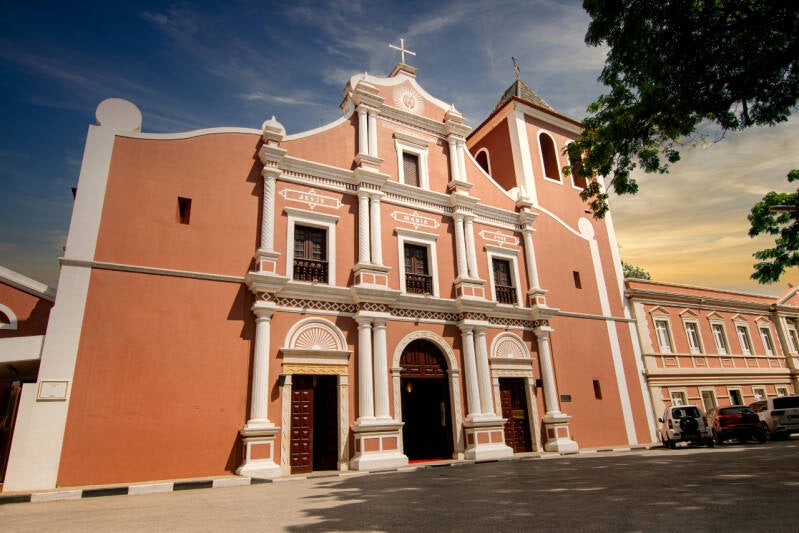
The former Church of Jesus is located in Luanda's Cidade Alta [Upper City], in Largo do Palácio. The architectural set includes the church and the buildings of the former Jesuit College where the Archiepiscopal Palace is now.
A very old church, it is still one of the most imposing temples in the Angolan capital. The admirable main façade, with vertical registers divided by pairs of columns, features the inscriptions JESUS, MARIA e JOSÉ [“Jesus, Mary and Joseph”], AD MAIOREM DEI GLORIAM [“For the greater glory of God”, the motto of the Society of Jesus], and the monogram IHS – alluding to Jesus Christ – at the top.
The portals have decorated frames and above the side portals there is a semicircle also with decorative motifs.
On the right-hand side is the bell tower with its pyramid shaped turret and the weathervane with the fame – a angel with a trumpet – built during the restoration works in the mid 20th century.
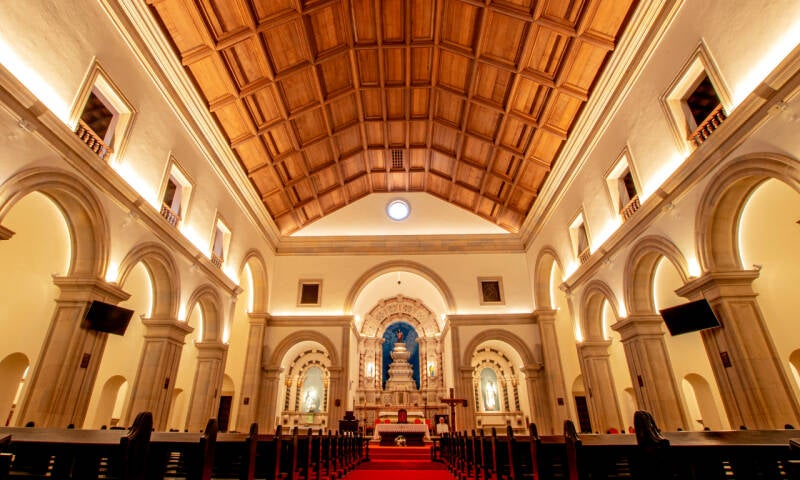
The interior is very spacious, lit by the windows on the main façade and indirectly by the windows in the side tribunes. The great nave, restored during the 1957/58 works, which sought to restore the original style, show now a very sober design.
At the entrance, there is a large atrium, the under-choir, according to the Jesuit traditional temple configuration.
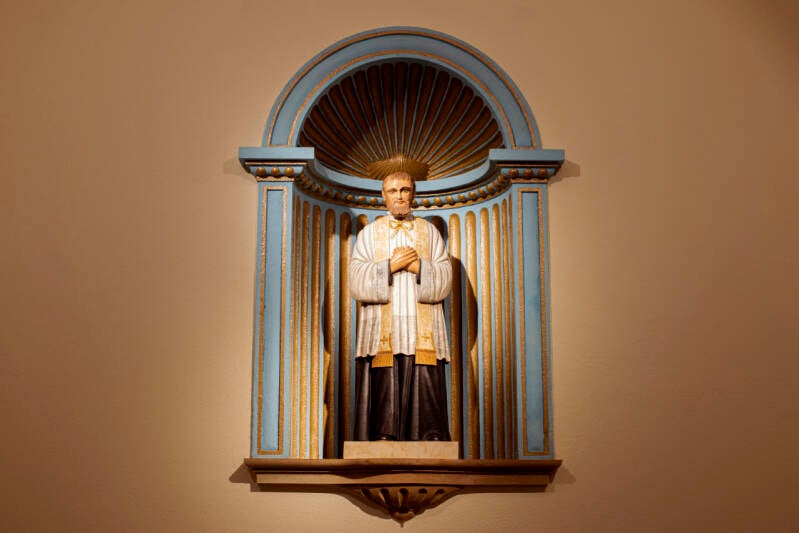
Highlight goes to the six connected side chapels, accessed through round arches, with a marble altar and bench – similar in design to the high altar –, a framed niche inlaid in the wall, and statues of each patron saint. They are dedicated, on the right: to Saint Elizabeth of Portugal, Saint Ignatius of Loyola – founder of the Society of Jesus – and Saint Anthony, a saint of great devotion throughout the church and particularly among the Portuguese Jesuits; and on the left, to Saint Joseph, the Sacred Heart of Jesus and Saint Francis Xavier.
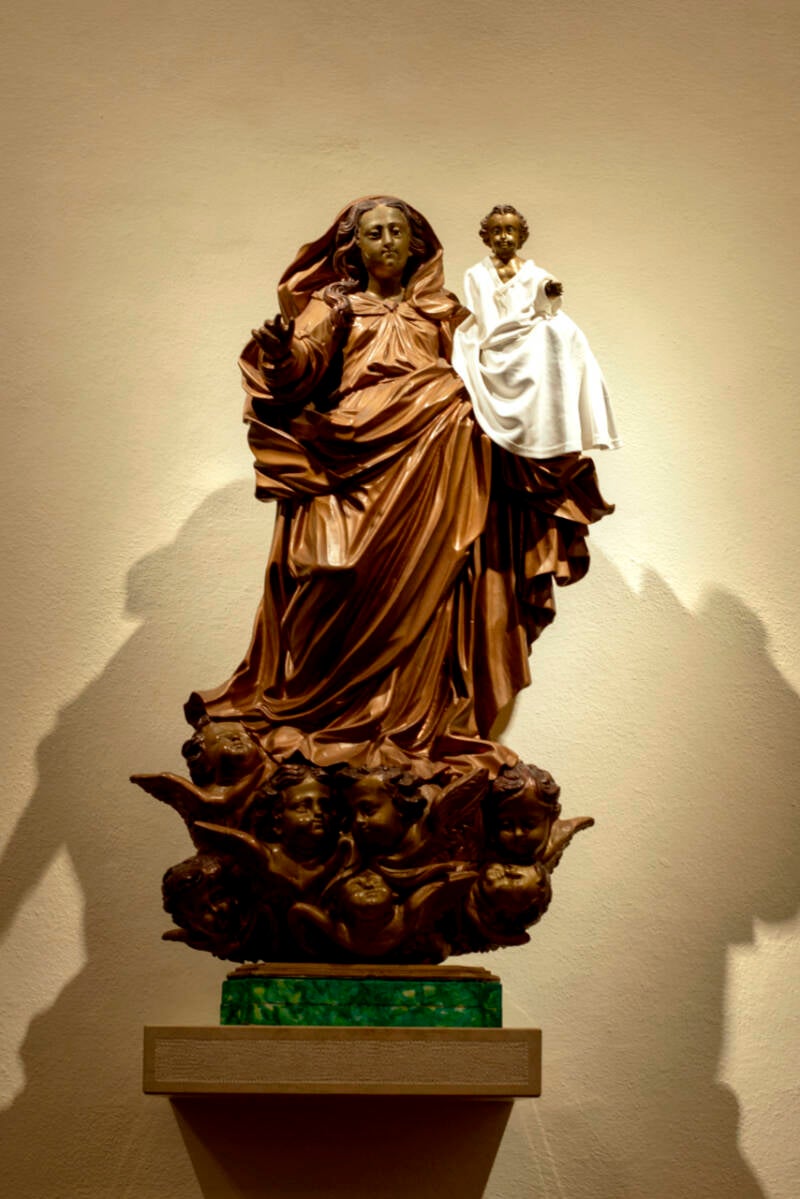
The transept is separated from the nave by a wooden balustrade. In the centre is the coram populo altar, placed after the reforms of the Second Vatican Council. On the right-hand side arm is an exquisite image of Our Lady with Child – possibly the one with the ancient invocation of Our Lady of the Rosary.
On the pavement, under the high altar stand, there is probably a tombstone with the Novais coat of arms and an inscription, placed during the restoration works in the 1950s, on the spot where mortal remains were found, possibly belonging to Paulo Dias de Novais.
The triumphal arch, a round arch, has two side chapels with Marian invocations from the beginning of the 18th century, inherited from the old church, with fine polychrome and marbled stucco altarpieces, solomonic columns and a structure similar to that of the main altarpiece.
The chapel of Our Lady of the Conception, the parish's invocation, has a tombstone on the wall with an inscription referring to a historic crucifix that has since disappeared: THIS IMAGE OF OUR LORD JESUS CHRIST IS THE ONE THAT WAS WORSHIPPED IN THE CHURCH OF OUR LADY OF THE ROSARY OF CAMBAMBE AND WAS PLACED HERE IN 1958 WHEN THIS CHURCH WAS RESTORED.
The chapel on the right is dedicated to the Immaculate Heart of Mary, Patroness of Angola (the country was consecrated to the Immaculate Heart of Mary on October 13th, 1985). The tomb of the distinguished Alexandre Cardinal Nascimento is here, with the inscription: “I have not hidden your deliverance within my heart (Psalm 40:11)”.
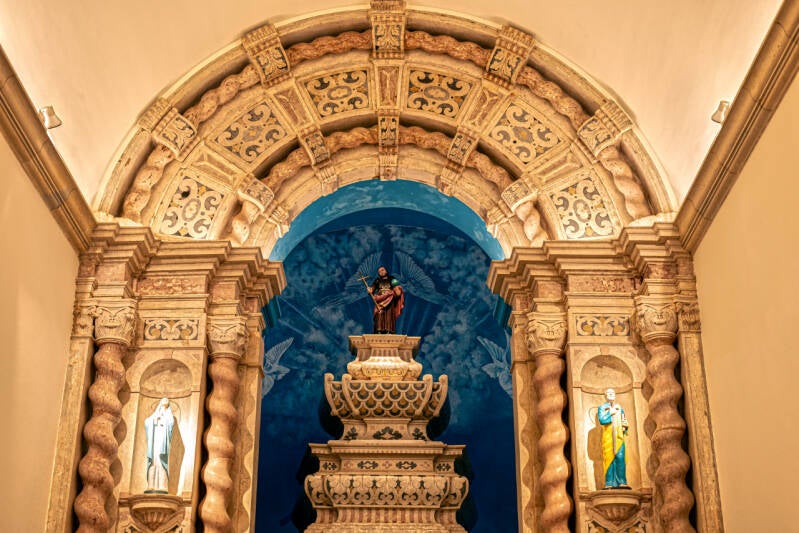
In the chancel, the magnificent altarpiece in polychrome stonework with inlays in white, red and black takes pride of place. It was the work of Master José Pereira, according to a contract signed on January 6th, 1711 with Fr. Francisco da Fonseca, procurator of the College of the Society of Jesus. It was made in a workshop in Lisbon and later transported to Luanda.
The altarpiece has a concave plan, with three axes defined by twisted columns; the central niche features a pyramidal throne also made of inlaid marble, containing the image of Jesus Christ Saviour of the World. In the side niches are the images of Our Lady of the Assumption and Saint Paul the Apostle, patron saint of the city of Luanda. The marvellous and monumental tabernacle, in the shape of a small temple, is at the base of the altarpiece. The whole ensemble rests on marble, including the altar table. It is an altarpiece of exceptional value, one of the first of its kind to be sent outside the Portugal mainland.
In the large vestry, also restored during the 1957/58 works, an 18th century lavabo takes pride of place.

III . THE JESUITS IN LUANDA
In the middle of the 16th century, the King of Ndongo, aware of the work of the Jesuits in the neighbouring kingdom of Congo, asked the King of Portugal to send missionaries to his land: “To the kingdom of Angola, (...), four Priests and [two] brothers departed this month of December. This kingdom is one thousand and five hundred leagues, and never until now has the gospel been preached here. This same king sent ambassadors to the King of Portugal, asking for Priests who could show him the path of salvation” (2).
The first Jesuits arrived at the Kwanza port on May 3rd, 1560, as part of the first embassy to the Kingdom of Angola, led by Paulo Dias de Novais. The group of missionaries included Fathers António Gouveia and Agostinho de Lacerda and Brothers António Mendes and Manuel Pinto.
The start of the missionary activity in the Luanda region was particularly difficult. While they were waiting for authorisation to go to Ndongo, Father Agostinho Lacerda died and was buried on the sands of the beach. When the embassy finally reached the lands of Ngola Ndambi (died in 1575), the King held them captive for six years. Paulo Dias de Novais was allowed to return to Portugal, but Father Francisco Gouveia remained, eventually dying in mid 1775, after a long period in captivity. In this group of four religious men, Brother António Mendes was the only survivor.
In February 1575, a new Jesuit mission arrived in the Luanda Island, as part of Paulo Dias de Novais’s second expedition. The group was comprised of Fathers Garcia Simões and Baltasar Afonso, and Brothers Cosmo Gomez and Constantino Rodrigues. They initially found accommodation in huts next to the existing chapel – which would later become the church of Our Lady of the Cape – and started helping the resident Portuguese community.
The following year (1576), they established their first residence on the hill of São Paulo, where a fort had been built, together with the chapel of Saint Sebastian, the eponym and patron saint of the King of Portugal; and Paulo Dias de Novais founded the town of São Paulo de Luanda. That same year, Father Garcia Simões also assisted in founding the Misericórdia of Luanda (a Portuguese charity).
From the hill of São Paulo, and with the arrival of more priests, particularly Father Baltasar Barreira in 1580, the Jesuits evangelised the people of Luanda and its outskirts; and they accompanied the Governor on various expeditions to the inland, particularly along the Kwanza River. They were also involved in the unfortunate slave trade: long established in the great African powers, this trade was intensely exploited by the native sobas, the African tribal chiefs, and Angolan traders, who took advantage of the existing trade networks.
In 1605/07, construction began on the church and college of Jesus in the upper part of the city, from where the excursions to the inland continued to depart.
For more than one century, the Jesuit College in Luanda was the main educational centre in the city and a training school for missionaries. The college was built next to the church, as customary, and was intended by the superiors to prepare future priests of the Society and to teach young people who wanted to learn the subjects taught there. In 1605, the school of first letters was opened, the first school in Luanda and possibly in the whole of sub-Saharan Africa. Students flocked there from the city, the Congo and other already evangelised Angolan territories. In 1622, although the works had not yet been completed, Grammar and Moral Theology classes began, and vocational education classes were provided in the enclosure of the college.
In the 17th century, the Society of Jesus was the main agent for ecclesiastical training, social work, specialised teaching and technical training in Luanda and Congo. The Jesuits studied African languages and published catechisms, as instruments not only for evangelisation but also for teaching the first letters. The Society played a fundamental role in promoting the writing of African languages – traditionally oral until then.
In 1641, teaching was interrupted when the Dutch occupied the college and turned it into the governor's residence, but classes resumed after the reconquest. In 1684, a proposal was made to set up a royally sponsored seminary, where twelve black boys would be taken to be taught and become priests.
Relations with Brazil intensified and, in the second half of the 17th century, the College of Luanda sent a large number of priests to the Jesuit colleges in Brazil.
With the expulsion of the Jesuits in 1760, following a decree by the powerful minister of King José I, education in Luanda fell into decline and neither the theological education nor the technical training previously provided by the clergy could be replaced on a regular basis.
The Jesuits returned to Angola in the late 20th century and are now part of the Central African Province.
IV . THE MOST HOLY NAME OF JESUS: CULT AND ICONOGRAPHY
The name of Jesus means the Saviour, and recalls the Salvation that came to us through Him and how admirably we were saved. The baby was named Jesus by Mary and Joseph, according to the indication received from God.
Devotion to the Most Holy Name of Jesus is very ancient, dating back to the apostolic period, when the name of Jesus was invoked by the first Christians asking for the courage they needed to face persecution and martyrdom, according to the Pauline invocation: “At the name of Jesus every knee should bow, in heaven and on earth and under the earth”, Philippians. 2:10.
In the Middle Ages, devotion developed with Saint Bernard (c. 1140), and Saint Bernardine of Siena associated the Christogram IHS with the Most Holy Name. Saint Ignatius of Loyola, founder of the Jesuits, had a great love for the Name of Jesus, which led him to name the Order the Society of Jesus and to include the monogram in the seal of the Society’s Superior. Many churches and colleges were founded by the Jesuits with this invocation, as is the case of the church and college in Luanda.
In 1721, the veneration of the Most Holy Name of Jesus was extended to the entire Roman Catholic Church, and the date of celebration was assigned to the second Sunday after the Epiphany. The reform of the liturgical calendar in 1969 abolished this feast, but Pope Saint John Paul II reestablished the Feast of the Most Holy Name of Jesus, currently celebrated on the January 3rd.
The iconography of this invocation includes the monogram of Jesus Christ – HIS, an abbreviation of the Greek name –, and the cross and the nails, usually three.
V . THE ARCHDIOCESE OF LUANDA
The Christianisation of what is now Angola started in the 16th century in the Congo region, under the jurisdiction of the Diocese of Funchal – the first diocese with territories outside Europe.
In 1534, the Diocese of São Tomé was created, which included the vast territories of the African west coast. In 1560, the first missionaries arrived at the mouth of the Kwanza River, but evangelisation expanded mainly from 1575 on, with the foundation of the town of São Paulo de Luanda.
In 1590, the first parishes had already been established in the region: Our Lady of the Conception in Luanda and Our Lady of Victory in Massangano.
In 1596, the Diocese of Saint Saviour of Congo was created by Pope Clement VIII, headquartered in Mbanza Congo, separated from the Diocese of São Tomé, covering the kingdoms of Congo and Ngola, including the Luanda region.
In 1623, the bishop established his residence in Luanda, and in 1676, during the tenure of Fr Manuel da Natividade (1620-1685), the seat of the so-called Diocese of Angola and Congo was definitively transferred to this city, headquartered in the church of Our Lady of the Conception.
In 1677, the diocese became subordinate to the Archdiocese of Baía, Brasil, which had been created in the meantime and was closely related with Angola. There were already numerous churches and convents in Luanda, as well as scattered throughout the region and in the different inland garrisons, as listed in the two reports (1690 and 1693) sent by Governor João de Lencastre.
Following the expulsion of the Jesuits, an attempt was made to set up the seat of the diocese in the Church of Jesus, but this was not possible as it was fairly dilapidated.
Between 1760 and 1778, the diocese went through a period of great difficulties in the relationship between the missionaries and the political power of Lisbon and Luanda. The seat of the diocese was sequentially based in different churches in the city.
By the end of the 18th century, the missionary situation continued to deteriorate, due to the decline of the religious orders, particularly after the decree that extinguished them was issued in 1834, and the prevailing anti-religious mentality.
Evangelisation was resumed at the beginning of the 20th century, through the remarkable work of bishops, the persistent labour of the new missions created in the meantime, and the firmness in training new clergy.
On September 4th, 1940, the diocese was elevated to Archdiocese of Luanda, at the same level as Saint Saviour, in memory of the original Cathedral of Congo. Two new dioceses were created – Nova Lisboa and Silva Porto (now Huambo and Kwito-Bié). The seat of the Archdiocese of Luanda was officially established in the Church of Our Lady of the Remedies. In 1978, the seat was finally moved to the old Jesuit church, which had been restored.
The diocese was visited by Pope John Paul II in 1992, in a difficult context of armed conflict, and by Pope Benedict XVI in 2009.
Today it is an expanding archdiocese: in spite of wars and internal conflicts, the church has developed due to the courageous missionary labour and the work of countless catechists.
- GABRIEL, Manuel Nunes, Padrões da Fé. As Igrejas antigas de Angola. Braga: Arquidiocese de Luanda, 1981, p. 56-58.
- BRASIO, António, Monumenta Missionária Africana, Lisboa, Agência Geral do Ultramar, 1953, Volume 2, p.449.
REFERENCES
- GABRIEL, Manuel Nunes, Padrões da Fé: As Igrejas Antigas de Angola. Braga, Edição da Arquidiocese de Luanda, 1981.
- SANTOS, Martins dos, Cultura, Educação e Ensino em Angola, Ed. Electrónica, Braga, 1998.
- DIAS, Pedro, História da Arte Portuguesa no Mundo (1415-1822), O Espaço Atlântico. s.l., Lisboa, Círculo dos Leitores, 1999.
- FERRAZ, Susana, Espaço Público de Luanda, Património arquitectónico colonial angolano e português, Dissertação de mestrado, Porto FAUP, 2005.
- MATTOSO, José (Dir.), Património de Origem Portuguesa no Mundo, arquitectura e urbanismo: África, Mar Vermelho e Golfo Pérsico. Lisboa: Fundação Calouste Gulbenkian, 2010.
- COUTINHO, Maria João Pereira, Ars marmoris: os mármores policromos do retábulo-mor da igreja do colégio da Companhia de Jesus de Luanda, As Artes Decorativas e a Expansão Portuguesa, Lisboa, 2010.
- MARIZ, Vera Félix, A “memória do império” ou o “império da memória” a salvaguarda do património arquitectónico português ultramarino (1930-1974), Dissertação de Doutoramento, Lisboa, Universidade de Lisboa, 2016.
PHOTOGRAPHY
- WEDOBRAND ( https://wedobrand.ao )
Adicionar comentário
Comentários