
Sanctuary of Muxima, Angola
On this page:
I . Historical and geographical context
II . History of the Sanctuary
III . Description
IV . The Fortress of Muxima
V . Our Lady of the Conception of Muxima
I . HISTORICAL AND GEOGRAPHICAL CONTEXT
Upon the arrival of the Portuguese in the territory of present-day Angola at the end of the 15th century, the newcomers found one of the most important population groups in sub-Saharan Africa prosperously settled, occupying a large territory and presenting an extremely rich oral tradition, including legends, proverbs and lineage titles.
The geographical area was taken by various relatively independent groups with less than clearly defined boundaries. In the neighbouring kingdoms of Congo was Ndongo, a territory made up of different tribes led by their own chiefs, that began a trade relationship with the Portuguese.
In February 1575, a new mission sent by the Portuguese Crown arrived in Luanda, accompanying Paulo Dias de Novais (c. 1510-1589); the tribal chiefs of this region would not be easily dominated, engaging in constant fighting and entering successive military alliances, both with the Portuguese and the local sobas [tribal chiefs].
While trade thrived in the region, fuelled by the large number of slaves captured in faraway lands and in the aftermath of the conquest wars, fortresses – garrisons – were built along the River Kwanza, facing the lands of Quiçama. Among them, the fortress of Muxima is particularly significant, as it was then an inescapable crossing point when travelling into the inland territories.
The settlement of Muxima was then created, including a church dedicated to Our Lady; it relied for its prosperity especially on the river port, where boats stopped over navigating up the Kwanza from Calumbo to Massangano, Dondo and Cambambe.
The evangelisation activity was no easy task due to the ancestral traditions of polygamy and idolatrous cults; the religious syncretism, that mixed superstition with Christian practice; the slave trade, that left in its wake a trail of depletion and mistrust; and the adverse environment, which imposed on the missionaries an exhausting struggle against disease and death.
II . HISTORY OF THE SANCTUARY
Erected by Baltazar Rebelo de Aragão on the left bank of the River Kwanza, the original church of Muxima was probably built in 1599, the same date as the construction of the fortress. This was an intense period of inter-tribal wars in Angola – the so-called Kwata-Kwata wars.
The church was dedicated to the Immaculate Conception of the Virgin Mary, according to the Portuguese tradition of adopting this invocation for the very first church in a given region. It was the place of burial of Governor João Rodrigues Coutinho (died in 1603).
In 1631, the parish of Muxima was mentioned in the report of the ad sacra limina visit by Bishop Francisco do Soveral (c. 1570-1642). The parish is thought to have been created around that time. The church served the population of the town that had been created in the meantime, particularly the military associated with the garrison, the small farmers who lived in the town and the traders who, travelling up the Kwanza, supplied the several ports on the river. The associated brotherhood is believed to have been also created, together with the Feast of Our Lady of Muxima which, according to Cardonega (1), had been held since the very early days.
In 1646, in anticipation of a Dutch attack on Muxima, the inhabitants, together with the military, took refuge in the fortress. After the reconquest of the region in 1648, the church was rebuilt, the respective brotherhood was probably also reestablished and the festivities in honour of Our Lady of the Conception of Muxima were resumed. In 1654, some Capuchin priests – Cavazzi de Montecúccolo, Antonio de Serravezza, Bento de Lusignano, Bernardino de Sena, Filipe de Sena and Ignacio de Valsássina – visited the sanctuary and witnessed the festivities that took place that year. In his História Geral das Guerras Angolanas [A General History of the Angolan Wars], published in 1680, Cardonega mentioned that the vicar was also the “chaplain of the infantry” and that the inhabitants were around “twenty couples with their homes and families” (1).
At the end of the 18th century, the absence of a resident parish priest was deeply felt. According to the 1797 report by Ensign Lourenço Joaquim de Santa Ana, the site of Muxima was neglected, with “a church temple of the patron saint of this garrison of Our Lady of the Conception of Muxima and no Ecclesiastical Minister, and there is only one sexton, a local, for some rosary prayers on Saturdays and Sundays, because there has been no parish priest in this garrison since the year Ninety” (2). The garrison lacked paper for records, and presumably so did the church.
In 1814, the captain-major of the garrison, Manuel Francisco Pacheco, drew attention to the fact that the church threatened to collapse because of the water: “Because the river overflowed, now the main staircase of the churchyard is in the river and, if care is not taken to form a wall to stop the water, the walls of the church will certainly fall” (3). In 1867 another report stated that “the right angle of the churchyard rested right on the edge of the cliff, so that it was subject to the first flood taking a chunk out of it” (3). There would be a protective wall in the future, yet, its building was not ordered until 1933.
In the first half of the 19th century, Muxima finally had parish priests, although intermittently. Between 1848 and 1850, the church was being repaired and, in 1853, the bell tower was built. It was also during the 19th century that the great festivals of Muxima took off, spreading beyond the town and attracting people in the neighbouring territories. The devotion grew and spread as far as the Luanda region. The miracles obtained through the intercession of Mama Muxima – the popular name at the time – originated a cult of gratitude including a variety of tributes.
According to an author from the end of the century, Father Gericota, “there is extraordinary devotion to Our Lady of Muxima on the part of the people of Luanda, from all the garrisons and districts (...), even from Quissamas and Libolos. All year round, devotees come from all over to ask for graces for all their needs, as well as to give thanks for favours received. And they never come empty-handed: (...) they offer Our Lady of the Conception what they can afford” (3).
From the last decades of the 19th century, a new drama unfolded in the region: the spread of the sleeping sickness, which killed a large part of the population. Pilgrims, including the fierce Quissamas, came from all the villages in Kwanza to ask for Mama Muxima's intercession. One of the parish books bears reference, on March 4th, 1872, to the offering of a soba to Our Lady of Muxima: “One thousand two hundred and ninety réis, worth seven pounds of wax, which the Soba of the lands of Nvula Queri spontaneously offered out of devotion, asking for the protection of the Blessed Virgin Our Lady of the Conception, so that the epidemic of sleeping sickness, which has killed several people, may end in his lands” (4).
In 1925, the church of Muxima (as well as the fortress) was classified as a Historical and Cultural Heritage Site. Between 1929 and 1933, the parish priest of Muxima was Father Manuel Ruela Pombo (1888-1960), who dedicated to restoring the parish inventory, a valuable piece of documentation on the history of the region.
In the middle of the 20th century, the church underwent an extensive restoration campaign under the responsibility of the National Buildings and Monuments Department of the Public Works Service. In 1956, it was classified (again, with the fortress) as a Property of Public Interest and the historic areas of Muxima were officially recognised.
During and after the troubled period that followed independence, the Sanctuary of Muxima regained its extraordinary role as a national pilgrimage centre. In 1992, Pope Saint John Paul II, on his visit to Angola, referred specifically to the Sanctuary of Our Lady, “affectionately called by you as Mama Muxima”.
In 1996, the church was included (with the fortress) on UNESCO's list to be of World Heritage sites.
In 2022, the foundation stone was laid for the construction of the new basilica, prepared to receive the thousands of pilgrims who year after year visit the Sanctuary of Our Lady of the Conception of Muxima, the heart of Angola and, possibly, of the whole of sub-Saharan Africa.
III . DESCRIPTION
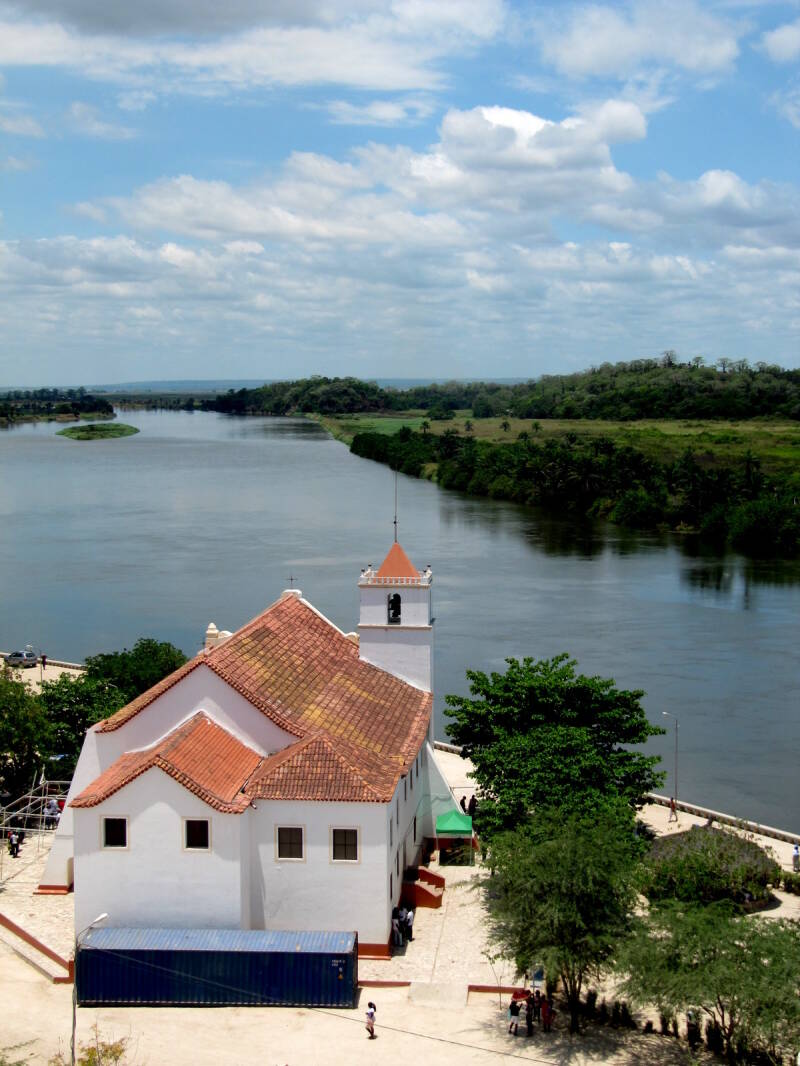
The church of Muxima is situated on the left bank of the River Kwanza, overlooking an immense and splendid scenery.
Initially, the river flowed close to the church, with a port for boats, the only means of access for many centuries. The threat of the river water rising during the flood season was a constant, and the reinforcement of the land was a concern for the competent religious and civil authorities.
The front churchyard, adapted to the slope of the land, is delimited by a wall, completed in the mid 20th century, along with the area surrounding the church.
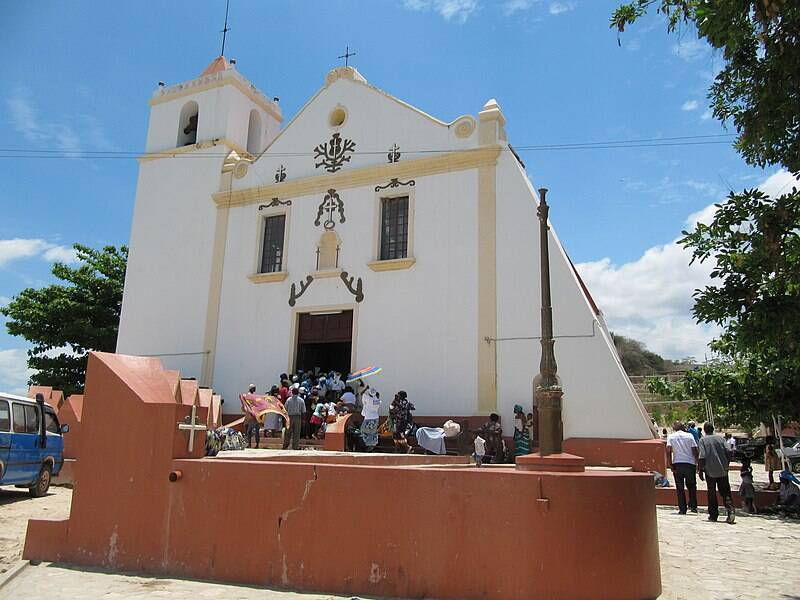
The main façade of the small stone church with a tiled roof has three openings. In the centre is a niche – where there was possibly an image of Our Lady of the Conception –, surmounted by a Latin cross above the world, surrounded by volutes. To the side are two big windows also surmounted by volutes. The pediment in triangular, with the characteristic wings at the ends.
On the left is the bell tower, built in 1853, with a pyramid shaped turret, covered with tile, like the church.
The church is laterally supported by solid buttresses, with round arched passageways.
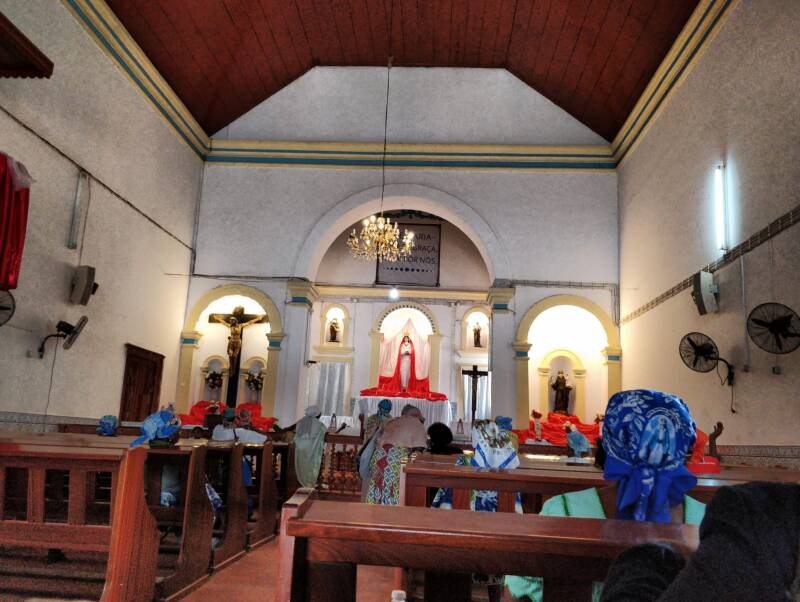
The inside is spacious and bright. The church's entrance hall is the under-choir, with the lower half of the pillars lined with tiles. The nave is also panelled in blue and white tiles. On the left is the pulpit, with a voluted and painted stone stand with a wooden rail. A wooden balustrade separates the nave from the presbytery.
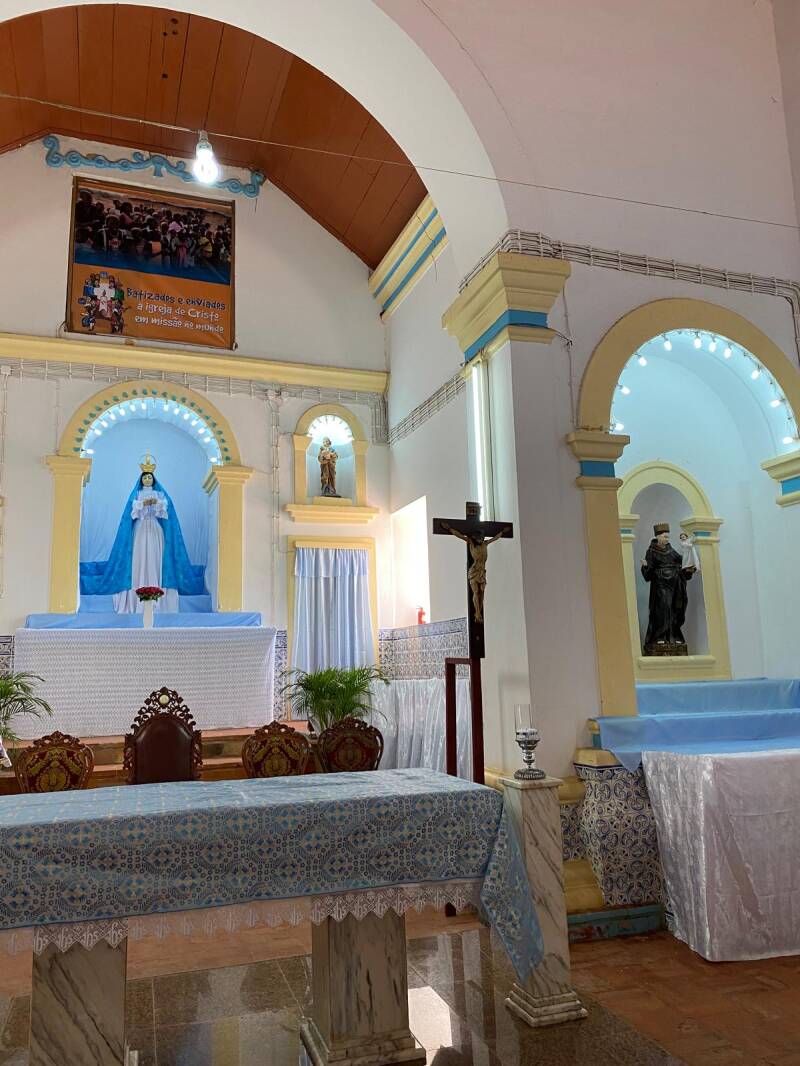
The round triumphal arch is flanked by two side altars: the altar of the Holy Christ - possibly the “chapel of the souls” mentioned by Cardonega (1) – with two interior niches; and the altar of Saint Anthony, with an image restored in 1964, of great devotion in this church due to its reference to the old fortress – Saint Anthony is the patron saint of the military.
In the chancel, in the centre of the altarpiece, is the venerable image of Our Lady of the Conception of Muxima, patron saint of the sanctuary. On either side, two small niches with images of Saint Joseph and Saint Anne and the Virgin Mary. The high altar is tiled in blue and white, as is the base of the walls.
The high choir, through which light penetrates from the two large windows on the main façade, features a wooden rail, similar to the balustrade of the presbytery and the pulpit.
IV . THE FORTRESS OF MUXIMA
In 1581, a small military post was set up on the banks of the River Kwanza by Paulo Dias de Novais, Governor of Angola, at the place called Muxima, “given this name by the soba lord of those lands, on the banks of the River Kwanza, named after being in the centre and at the heart of that country, for Muxima in the ambundo language means heart and entrails (5).
In 1599, by order of Governor João Furtado de Mendonça, Baltazar Rebelo de Aragão built a garrison here to replace the military post. This was a very simple building, referred to in 1606 as nothing more than a set of rammed earth walls.
In 1609, by order of Governor Manuel Pereira Forjaz, the garrison/fortress was moved to the top of the hill, with a better view over the river and its banks, where it has remained until the present day.
The Fortress of Muxima, located on the main route into the inland, was an important trading post for the transport of goods and slaves captured in the inland.
In 1646, the Dutch invaders ransacked and burned the church and the town in 1646, but they were unable to enter the fortress. Allied Portuguese forces and native tribes took part in the famous resistance and defence of Muxima. After the reconquest, the fortress was rebuilt in 1655 by Captain Francisco de Navais, as shown on the stone coat of arms at the entrance.
As well as defending against attacks from the Flemish and some of the surrounding populations, the Muxima garrison also served as a place where convicts were taken, including Domingos de Abreu Vieira, the famous conspirator linked to the Minas Conspiracy, who was deported from Brazil in 1792.
In his 1846 report, Ensign Sampaio referred to the fortress as “a beautiful viewpoint on all sides, from where you can perfectly see the Quisua lagoon” (3). Lopes de Lima described it as being “made of stone and lime (...), manned by a company of one hundred and thirty first-class soldiers”; the settlement had “around five hundred houses, two or three of which were made of stone and the rest were huts” (3).
The fortress of Muxima is situated on a hill with a remarkable view over the River Kwanza. It has a polygonal shape that follows the contour of the river and leans on the hill. It is comprised of three bastions, with singular cylindrical guardhouses at some angles. Some walls are reinforced by buttresses, which lend a solid appearance to this military architecture.
Access is via a steep path that leads to the entrance portal, located to facilitate defence. The portal has a depressed arch and is topped by a tombstone with the Portuguese coat of arms and the inscription O CAPITAÕ – FRANCISCO DE NAVAES A FES – 1655 [“Captain – Francisco de Navaes built it – 1655”], relating to the rebuilding after the region was reconquered.
The inside unfolds with a series of planes and intersections, stairs, ramps and parapets. It has two service houses, formerly used by the guards and as the ammunition store. It still retains the six old cannons placed along the walls, used during the Dutch siege in 1646. It is currently visited by pilgrims of the sanctuary, a living memory of a place with historical roots.
V . OUR LADY OF THE CONCEPTION OF MUXIMA
The original church of Muxima was dedicated to Our Lady of the Conception, a very old devotion in Portugal, whose feast day is celebrated on December 8th. It spread to overseas territories after the 16th century, particularly in Angola, where several churches adopted this invocation.
The original statue of Muxima is thought to have come from Portugal, as was common at the time, and was made in late 16th century, about the time when the construction of the sanctuary started.
Different versions are associated with the history of the image.
According to Cardonega's account, a second image of Our Lady of the Conception arrived in Muxima in 1641, originally from the gone mother church of the Conception in Luanda. It would have been saved by Beatriz Pais, the wife of Captain-major Sebastião Pinheiro, when Luanda was attacked by Flemish forces, and taken by Governor Pedro César de Meneses (died in 1666) to Muxima, accompanying the fleeing population of Luanda, and then to Massangano and Outeiro do Gango; from here it was taken to the Congo.
In 1646, the inhabitants of Muxima, perceiving that the Dutch attack was imminent, took the original image in procession to the fortress, where a “little wooden house” was built to protect it. When the military forces coming from Massangano to help the besieged entered the fortress in 1647, they found the image “under the wooden house, with its straw roof burnt off, riddled with bullets” (1).
After the liberation of Luanda, the (second) image of Our Lady of the Conception – the one that had been taken to the Congo – was sent to Father Manuel Rodrigues, a priest in Luanda, to be repaired, and was recognised by two locals, Lieutenant-general Manuel Carneiro de Medeiros and trader Baltasar Figueira Borges. It was then taken festively to its church (in Muxima), followed by all the people of Muxima and Massangano, and this was the image that remained there for many decades.
The current image, which is no longer the original one, is around 1.60 m tall and was for a long time a clothed statue. In 2000, a previously carved wooden body was attached to the image, giving it its current shape. The Virgin has a white garment and a blue mantle trimmed with gold that covers her head and body. She is crowned and holds a rosary in her hand.
The Marian worship in Muxima was intense from the start. In 1654, when the Capuchin priests visited the sanctuary, they witnessed the festivities that had been taking place for a long time during the octave of the Immaculate Conception of Mary, celebrated on December 8th. People came from all the surrounding regions, sometimes travelling many kilometres for days on end to get there. Originally, access was only via Kwanza River, by canoe. People came all year round but particularly during the Feast of the Immaculate.
The pilgrims made (and still do) offerings of objects, products from the land – flour, maize, palm oil, peanuts and many other things – according to their cultural tradition – and even services (during the period of slavery, the church of Muxima had many slaves at its service, made available by the pilgrims as a sign of gratitude). From Portugal came a gold crown donated by Queen D. Maria I (1734-1816).
During the 20th century, it was still customary to write letters to Mama Muxima – the letters of Muxima – asking for help with afflictions and expressing wishes. Letters were a choice mainly for those who could not go to the sanctuary in person.
Originally celebrated on December 8th, the feast of Our Lady of Muxima is now held in the first week of September, during the dry season, when access is easier.
The cult of Our Lady of Muxima has spread to the American continent: on April 14th, 2013, an image of Our Lady of Muxima was solemnly enthroned in the famous Sanctuary of Our Lady of Luján, in Argentina, by the Bishop of Viana (Angola), Joaquim Ferreira Lopes; on September 30th, 2017, the same happened in the church of Our Lady of Fatima in New York (United States) and, on October 21st, 2018, in the church of Our Lady of the Rosary of the Black in Baía, Brazil.
- CARDONEGA, António de Oliveira, História Geral das Guerras Angolanas (1680). Lisboa: Agência Geral do Ultramar, 3 Vols. (Anotado e corrigido por José Matias Delgado e Manuel Alves da Cunha), 1972.
- CURTO, José C., O arquivo paroquial de Muxima: inventário e considerações sobre uma fonte arquivística quase perdida, AFRICANA STUDIA, Nº41, 2024, Edição do centro de Estudos Africanos da Universidade do Porto, p. 177.
- GABRIEL, Manuel Nunes, Padrões da Fé: As Igrejas Antigas de Angola. Braga, Edição da Arquidiocese de Luanda, 1981, p. 161-164.
- Diogo Cão, II Série, Nº 9, 1934, p. 286.
- Diogo Cão, II Série, Nº 8, 1934, p. 235.
REFERENCES
- BATALHA, Fernando, Muxima. Luanda, Angola: Direcção dos Serviços de Obras Públicas e Transportes - Monumentos Nacionais, s/d.
- GABRIEL, Manuel Nunes, Padrões da Fé: As Igrejas Antigas de Angola. Braga, Edição da Arquidiocese de Luanda, 1981.
- Fernandes, Odílio, Os azares de Nossa Senhora da Muxima: Um percurso de trocas, movimentações milagrosas e intolerância, Revista Angolana de Sociologia, 14, 2014.
- MARIZ, Vera Félix, A “memória do império” ou o “império da memória” a salvaguarda do património arquitectónico português ultramarino (1930-1974), Dissertação de Doutoramento, Lisboa, Universidade de Lisboa, 2016
- LOPES, Dom Joaquim Ferreira, Santuário de Nossa Senhora da Conceição da Muxima do século XVI ao início do século XXI. [S.l. : s.n.], 2023.
- CURTO, José C., O arquivo paroquial de Muxima: inventário e considerações sobre uma fonte arquivística quase perdida, AFRICANA STUDIA, Nº41, Edição do centro de Estudos Africanos da Universidade do Porto, 2024.
Adicionar comentário
Comentários
Muitos parabéns pela trabalho de investigação e reportagem fotográfica. Parabéns à Isabel Nunes!!!