
Church of Our Lady of the Cape, Luanda
On this page:
I . History
II . Description
III . Our Lady of the Cape: cult and iconography
I . HISTORY
The first governor of Angola, Paulo Dias de Novais (c. 1510-1589) found a completely built chapel on the Island of Luanda upon landing there in February 1575.
The island was inhabited by a large population – the bacongo – together with around forty Portuguese traders, who had fled the Congo wars and had built there a chapel dedicated to Our Lady of the Conception.
A possession of the King of Congo, the island was where the king based the lucrative trade of zimbo or nzimbo [cowrie shell]: “This island is the mine of Congo, for it is here that they fish for the cowrie shell, a currency that flows throughout this land” (1). Descriptions from the time report seven different settlements on the island.
The first landing was a remarkable show of religiousness. Paulo Dias de Novais disembarked on the island in great solemnity, accompanied by a mission of four Jesuits, with Father Garcia Simões as their superior. They went in procession to the original chapel of Our Lady of the Conception – with all the people from the ships –, carrying the relics of the “Eleven Thousand Virgins” with “great devotion”, and there was celebrated the first Mass: “Governor Paulo Dias de Novais stepped on the Island of Luanda with all his people; and they set off in a devout procession, with magnificent and religious pageantry, preceded by trumpets and other warlike instruments and by a Priest carrying some Relics under his pallium (...). There, on a portable altar, Mass was celebrated (...). An infinite number of black people who lived on the Island of Luanda attended to see these acts” (2).
Paulo Dias de Novais met the most prominent personalities in the island and the Jesuits settled in huts next to the chapel.
The King of Congo, D. Álvaro I (c. 1530-1587), lord of the island, sent an embassy with a large retinue of one hundred slaves and plenty of cattle. The embassy was met by Paulo Dias de Novais, by the chapel, on the 29th June. “On the day of Saint Peter and Saint Paul came this ambassador. The Governor, knowing that he was still on the island, came here to receive him; because no other place was better suited than our hut, the Governor insisted on receiving him here” (1).
It was also with great pomp that Paulo Dias de Novais met the ambassador: “So came the Governor in six vessels with almost all his people, all of them well dressed and polished and saying prayers in the church, which was pleasant and decorated with branches and plants. He entered the house flanked by two priests on either side, one of them who was here before and the other a priest that he had brought with him, took the seat that had been prepared for him, and from here sent some of his leading men to fetch the ambassador, who immediately accompanied them back along with his own company and his people” (1).
With the permission of the King of Congo, Paulo Dias de Novais moved to the mainland the following year (1576), where he founded the town of São Paulo de Luanda.
About half a century later, the small chapel had turned into a ruin under the Dutch rule (1641-1648), as had most of Luanda's churches and convents.
After the Portuguese rule was restored in 1648, a new church dedicated to Our Lady of the Cape was erected on the site of the original chapel, thus replacing the former patron saint, Our Lady of the Conception. A Brotherhood was set up and in 1669 it was granted by the government the concession of a vacant plot of land “extending from the chapel and the house of Our Lady to the coconut grove of the Reverend Fathers of the Society of Jesus” (3).
The church, situated on the tip of the island, was attended by a chaplain in charge of celebrating mass and maintaining the worship, and by a hermit.
In a report of 1694, it was confirmed that mass was celebrated in the church on Sundays and holy days, and that it was attended by the locals. The island was home to “some white people, many black people, slaves of the city's residents (...) and also some freedmen” (4).
The church was not mentioned as a parish in the reports from the 17th and the 18th centuries. The Muxiluandas of the island attended the church of the Remedies in the city – therefore also known as the parish of the Muxiluandas.
The 18th century saw a deterioration in the religious life, mainly due to the moral decline associated with the slave trade added with the expulsion of all religious orders dictated by the 1834 decree, which left many churches and convents abandoned and in ruins. In the mid 19th century, according to the writings of the time, the church still had no care of souls.
On September 1st, 1854, the church of Our Lady of the Cape was elevated to parish church, replacing the church of Saint John the Baptist of Cazanga, which was then in complete ruin. The request was made by the commander of the islands, Joaquim Eugénio Ferreira, and by the residents, and was granted by Bishop Joaquim Moreira Reis (1812-1887), possibly on the grounds that the population of the Island of Luanda was the largest among the islands. However, due to a lack of clergymen, it was not until 1861 that a parish priest was assigned by the new Bishop Manuel de Santa Rita Barros (1810-1862).
The church, which had sustained severe damage, started to be restored in 1870, the restoration works being the responsibility of a committee of residents, with budget approved by acting governor-general Joaquim José da Graça (1825-1889). The Nazareth chapel served as the parish church for some years during the restoration works.
In 1949, the church was classified as a Property of Public Interest by the National Institute of Cultural Heritage.
In 2021, it was appointed as Historical and Cultural Heritage Site by the Minister of Culture, Tourism and the Environment.
II . DESCRIPTION
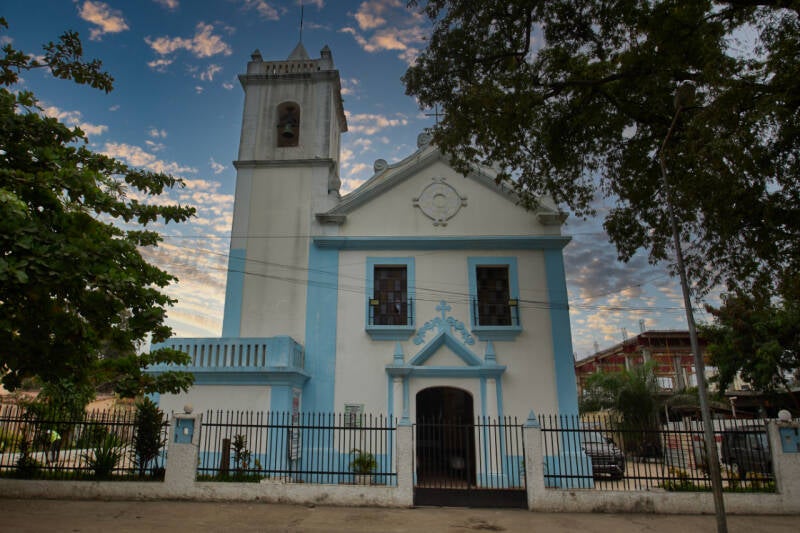
The church of Our Lady of the Cape is built in stone and maintains a peculiar configuration, with a whitewashed and very simple frontage.
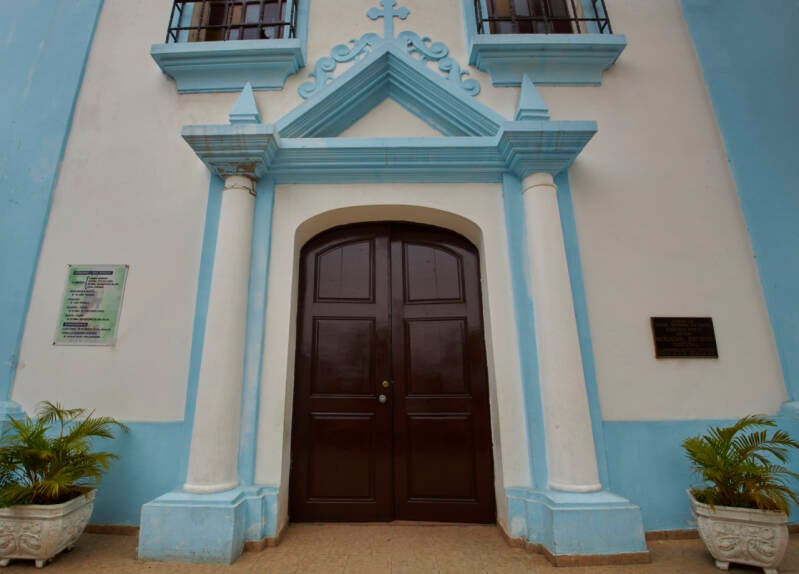
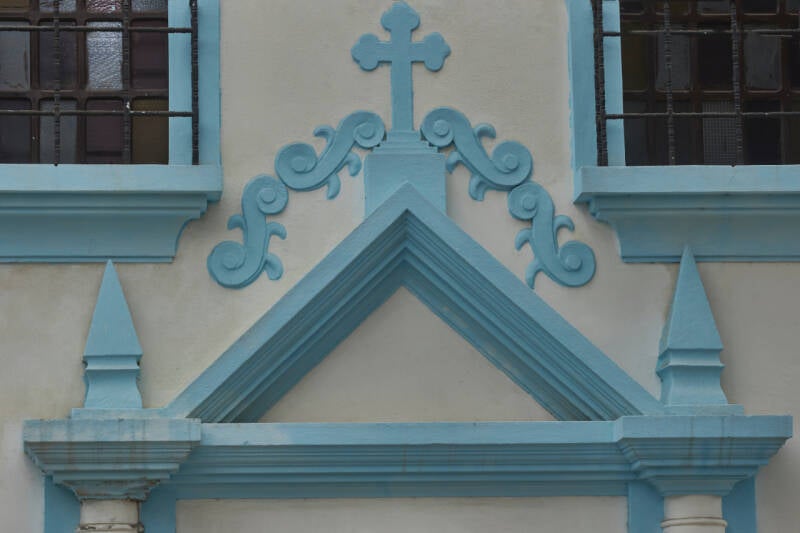
The main façade faces South-east. The portal, with a depressed arch, is flanked by columns with pinnacles; in the triangular frontal, one of the quadrants was possibly the base of a former clock. The tympanum has a striped and voluted cartouche, as does the façade’s finial.
On the left is a graceful bell tower, topped by a balustrade with acroteria. At the base stands a singular quadrangular body, also with a balustrade, accessed by an external staircase.
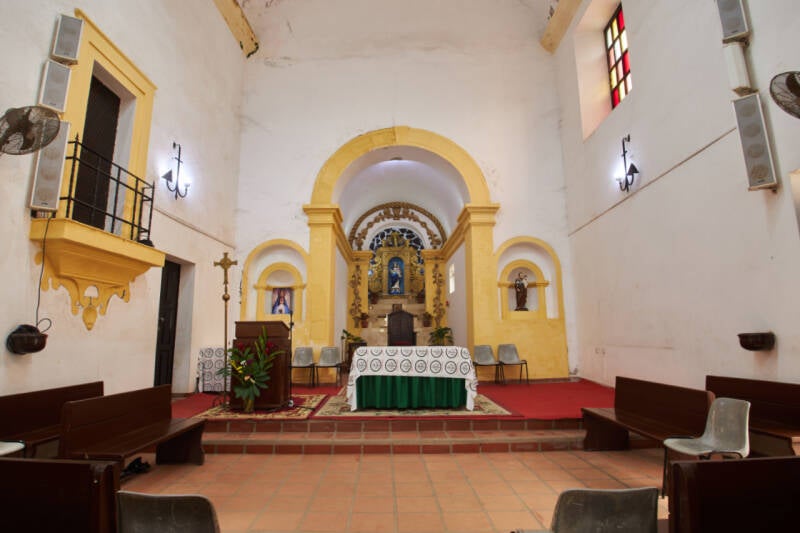
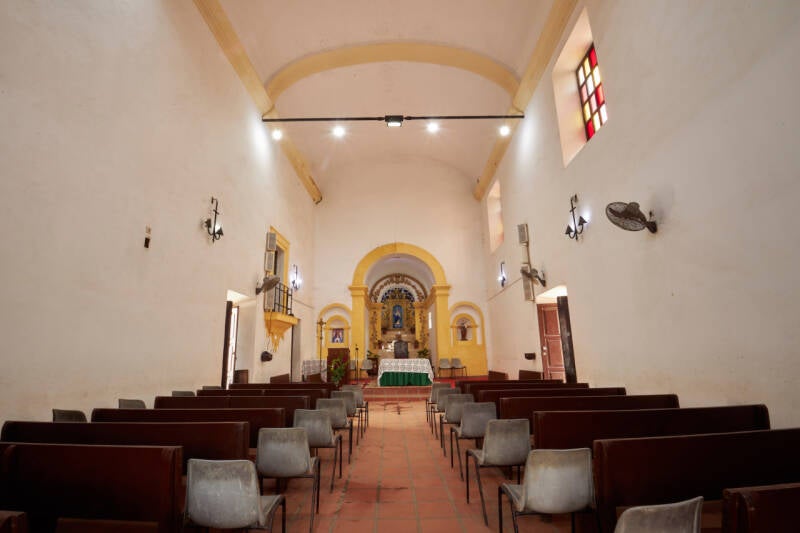
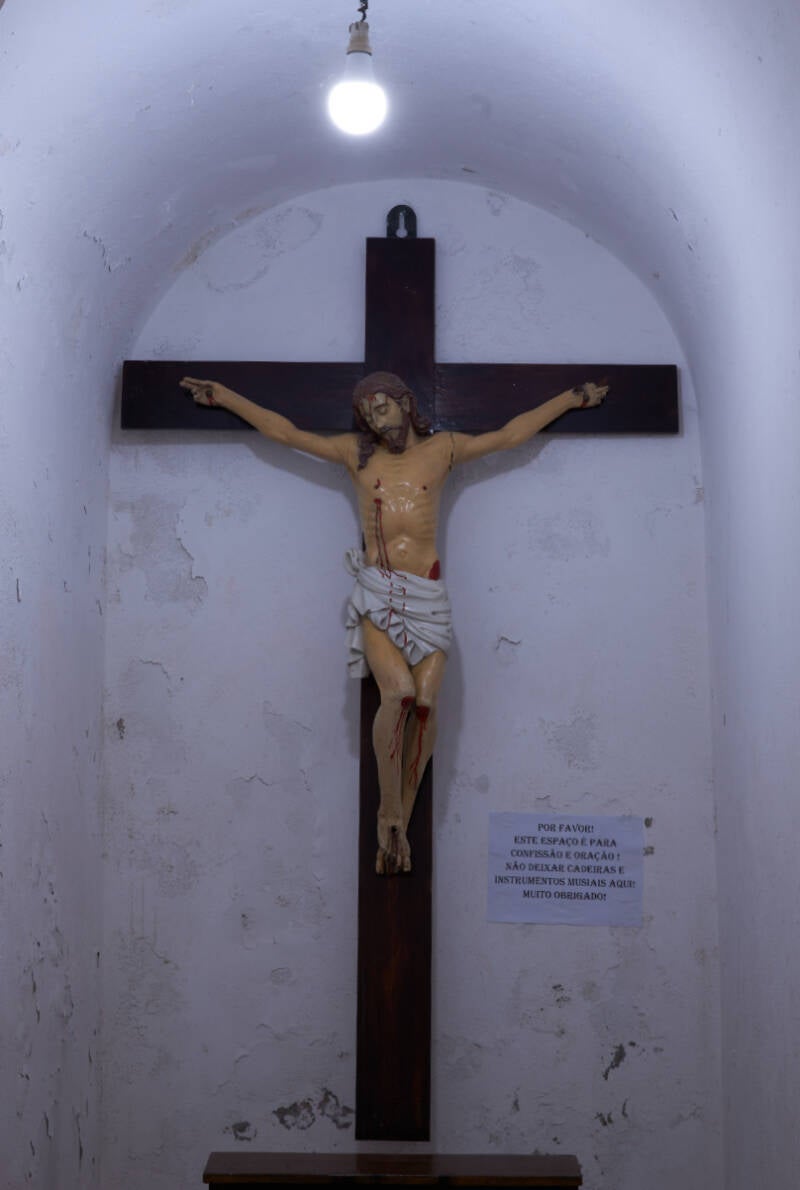
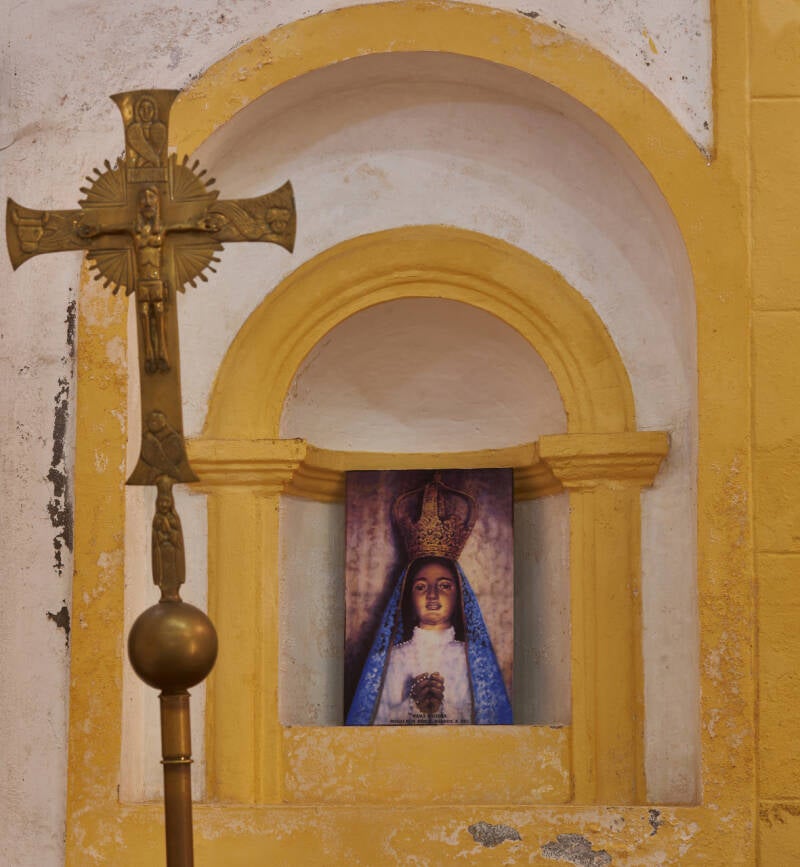
The interior is particularly well lit, with white walls framed in yellow. At the entrance on the left is a large-sized crucifix, an expressive symbol of local devotion.
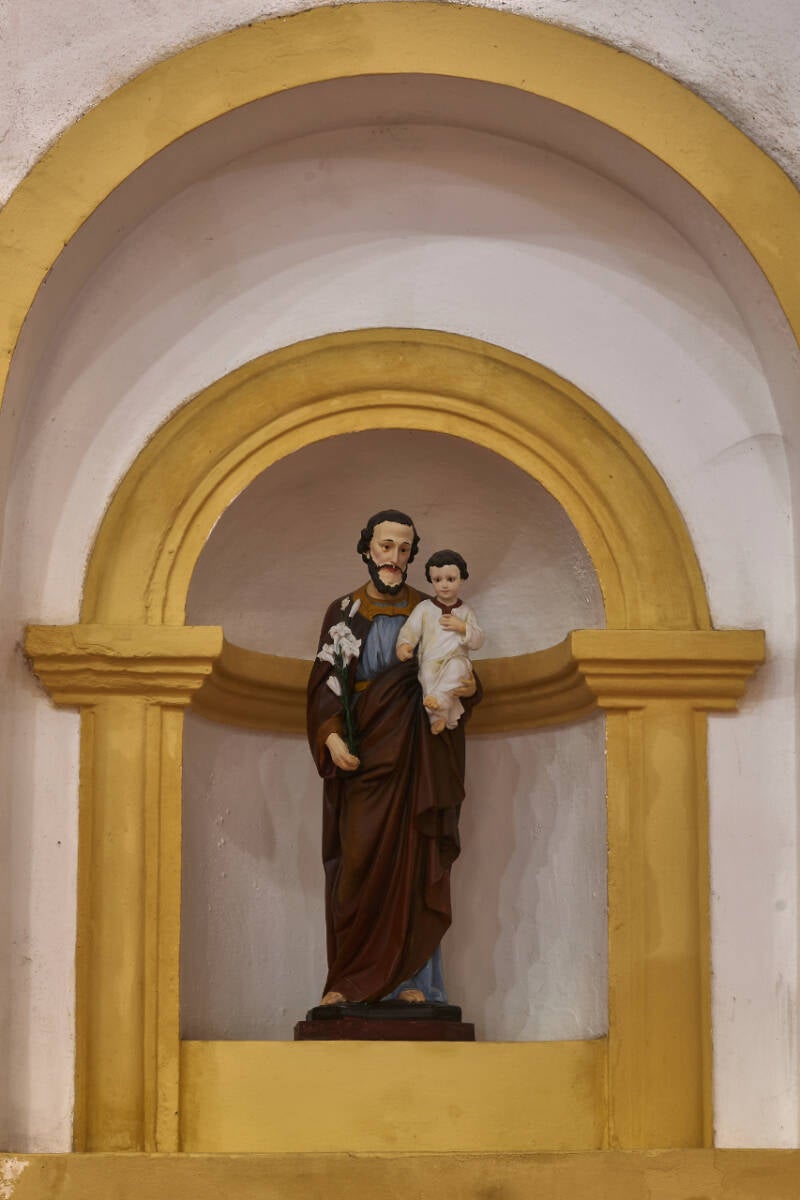
In the simple nave, the pulpit stands out on the left, with a decorated stone base, also painted yellow, with iron railing. The triumphal arch, a round one, is flanked by two graceful double-moulded niches with images.
Worth a note is the small chancel, also in the same shades of colour, illuminated by a window on the right-hand side. On the back wall, the arch has side elements in gilded wood carving and is delimited by a twisted archivolt.
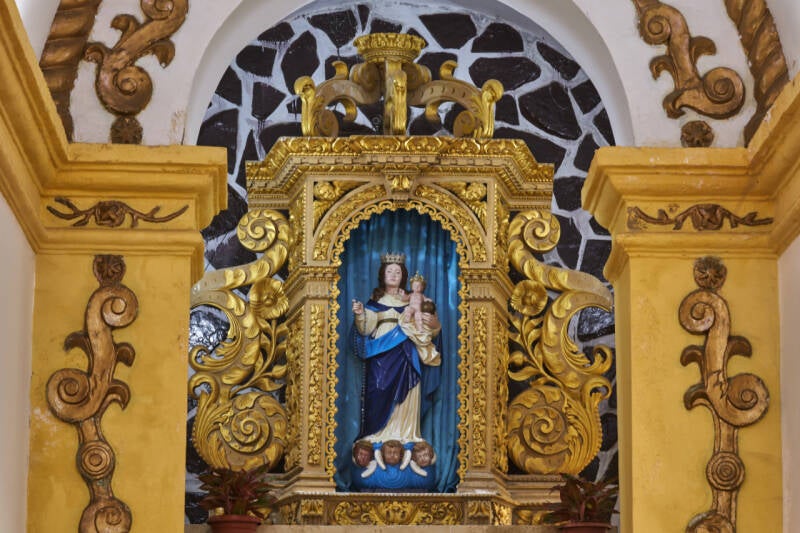
The precious altarpiece has a gilded carved structure. In the niche stands the honourable image of Our Lady of the Cape, the patron of the church. In the gilded woodwork surrounding the Virgin a profusion of flowers and fruit makes this altarpiece particularly valuable. The altarpiece structure has large, hollowed-out side wings, also in gilded woodwork, and is topped by a crown – a possible allusion to the Mother of God, Queen of Heaven.
The small tabernacle is integrated into the lower part of the altarpiece.
III . OUR LADY OF THE CAPE: CULT AND ICONOGRAPHY
According to tradition, the invocation of Our Lady of the Cape was chosen due to the church’s particular location on the island when it was newly built in 1669. The parish church of Luanda, where Our Lady of the Conception was also invoked, was probably taken into account in this choice.
The faience image of Our Lady of the Cape is of great beauty. The Virgin has a blue mantle and a light-coloured garment. She is holding the Child Jesus in her left arm, who in turn rests one of his hands on a sphere – the world – while blessing with the other. Both figures are crowned. At the base are three cherubs. The Virgin would have possibly been holding a flower in her right hand.
The festivities in honour of Our Lady of the Cape, patron saint of the fishermen, particularly popular on the island, are celebrated in November.
- Carta de Garcia Simões para o Provincial, de São Paulo de Luanda, a vinte de Outubro de 1575 in FERRAZ, Susana, Espaço Público de Luanda, Património arquitectónico colonial angolano e português, pp. 137, 272 -279.
- Cardoso, Feo, Memórias in FERRAZ, Susana, Espaço Público de Luanda, Património arquitectónico colonial angolano e português, p. 105.
- História Eclesiástica – A Ermida de Nossa Senhora do Cabo da Ilha-de-Luanda, 1669, Secção dos Manuscritos da Biblioteca Municipal de Luanda, livro 7399, às fls. 133, v. e seguintes, in Diogo Cão - Revista Ilustrada de Assuntos Históricos, I Série Angola Nº 6, 1932, pp 172-176.
- GABRIEL, Manuel Nunes, Padrões da Fé: As Igrejas Antigas de Angola. Braga, Edição da Arquidiocese de Luanda, 1981, p. 130.
REFERENCES
- DELGADO, Ralph, História de Angola, Edição do Banco de Angola, 1948.
- GABRIEL, Manuel Nunes, Padrões da Fé: As Igrejas Antigas de Angola. Braga, Edição da Arquidiocese de Luanda, 1981.
- FERRAZ, Susana, Espaço Público de Luanda, Património arquitectónico colonial angolano e português, Dissertação de mestrado, Porto FAUP, 2005.
- MATTOSO, José (Dir.), Património de Origem Portuguesa no Mundo, arquitectura e urbanismo: África, Mar Vermelho e Golfo Pérsico. Lisboa: Fundação Calouste Gulbenkian, 2010.
PHOTOGRAPHY
- WEDOBRAND ( https://wedobrand.ao )
Adicionar comentário
Comentários