
Sanctuary of Our Lady of Nazareth, Luanda
On this page:
I. History
II. Description
III. The tile panels in the chancel
IV. Our Lady of Nazareth: cult and iconography
I . HISTORY
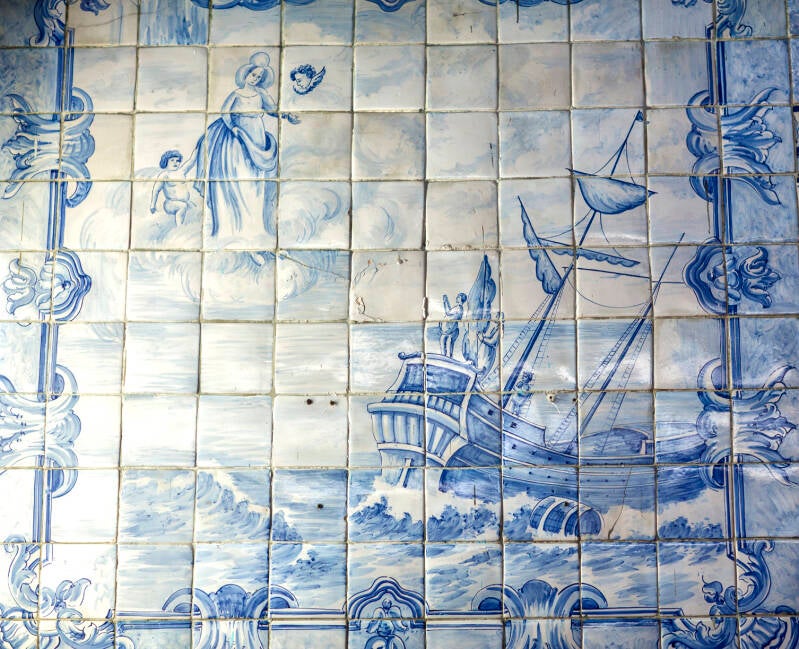
The church of Our Lady of Nazareth was built in 1664 next to the bay of the city of Luanda by André Vidal de Negreiros (1606-1680), in gratitude for having been saved from shipwreck on his voyage from Brazil to Angola. The miracle was attributed to Our Lady of Nazareth, who was the subject of great devotion in Pernambuco. André Vidal de Negreiros also set up the Brotherhood of Our Lady of Nazareth, of which he was the first judge.
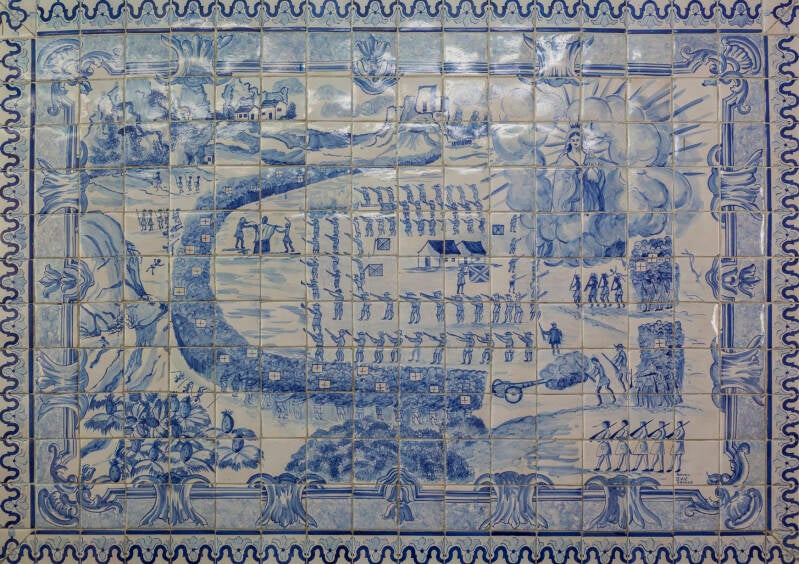
The following year, in 1665, the burial of the head of King António I of Congo (King Nvita-a-Nkanga) took place here in a solemn ceremony. The King died in the famous Battle of Ambuíla, that took place in October 29th that same year and was one of the greatest battles of warriors in Africa, decisive both for the Kingdom of Congo and the future of Angola. The King's crown – the historic crown given by Pope Innocent X to his predecessor, King Garcia II – was placed next to the image of Our Lady, to whom the victory of the Portuguese and the Angolans in the battle was attributed. This event was initially represented in paintings on the side walls, replaced in the 18th century by tile panels.
In 1869, major works were carried out. That same year, the church was handed over to the Spiritan Fathers – their first mission in Luanda – in the person of the young and active missionary Father José Fulgêncio Lapeyre (died in 1870).
In 1886, at the request of the parishioners, the Brotherhood of Our Lady of Nazareth – which had been extinguished – was revived by Bishop António Tomás da Silveira Leitão e Castro (1884-1891). The festivities for the revival of the brotherhood were held with great solemnity on February 1st and 2nd, 1887.
In March 1909, heavy rain caused the roof to collapse as well as other extensive damage, which led to the suspension of worship.
After the old chapel of Our Lady of Nazareth was classified as a National Monument in 1922 – the first monument to be classified in Angola –, the restoration works were particularly boosted and would be completed in 1935. They included the construction of the stone wall and the iron railings in the churchyard. On March 19th, 1939, the sanctuary was solemnly reopened by Bishop Moisés Alves de Pinho (1883-1980) of Angola and Congo.
In the following years, the 18th century tile panel on the church's triumphal arch, depicting Our Lady of Nazareth, was replaced with a simplified copy.
In 1957, the church became the seat of the parish vicariate, and in 1961 it was appointed as parish church by Archbishop Moisés Alves de Pinho.
In the 1970s, the many problems of the temple prompted further intervention. It was probably at this time that the famous tile panels in the chancel, which were then quite deteriorated, were restored in a simplified version.
Frequently hit by adverse weather, the church has always been restored.
With memories of countless miracles, the Sanctuary of Our Lady of Nazareth maintains the traditions of Marian devotion.
II . DESCRIPTION
The Sanctuary of Our Lady of Nazareth is located in a privileged central area, next to the Luanda Bay. The temple essentially retains the structure of a church of pilgrimage, with side porches, balconies and windows on the lower floor flanking the portal. In the churchyard there is an old stone cross.
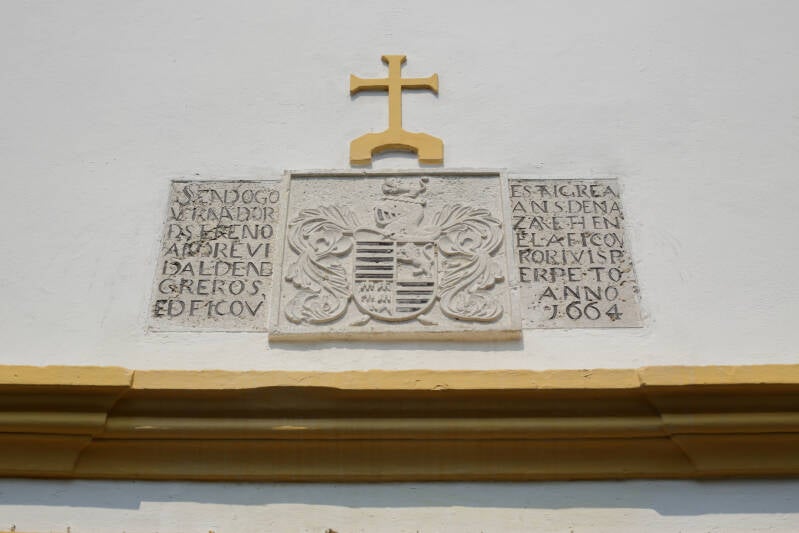
The main façade, of great simplicity, has a tombstone with a coat of arms and inscription above the portal:
BEING GOVERNOR OF THIS KINGDOM ANDRÉ VIDAL DE NEGREIROS BUILT THIS CHURCH TO OUR LADY OF NAZARETH AND THERE HE STAYED AS PERPETUAL JUDGE YEAR 1664.
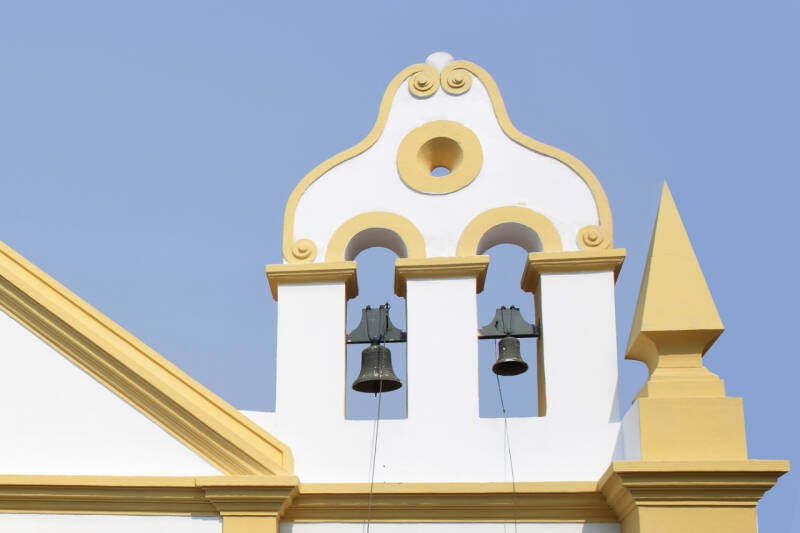
The façade is flanked by porches with small flying buttresses and round arches. On the right-hand side, the tower has a unique bell tower with two bells, topped with cut-out volutes.
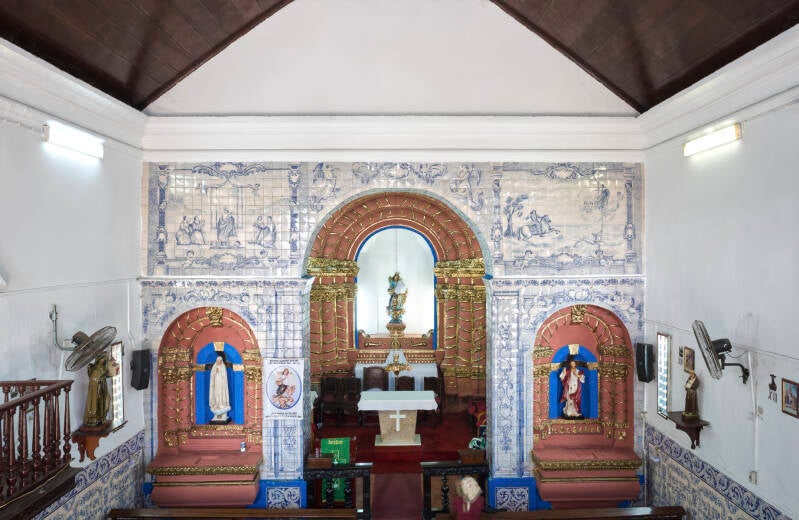
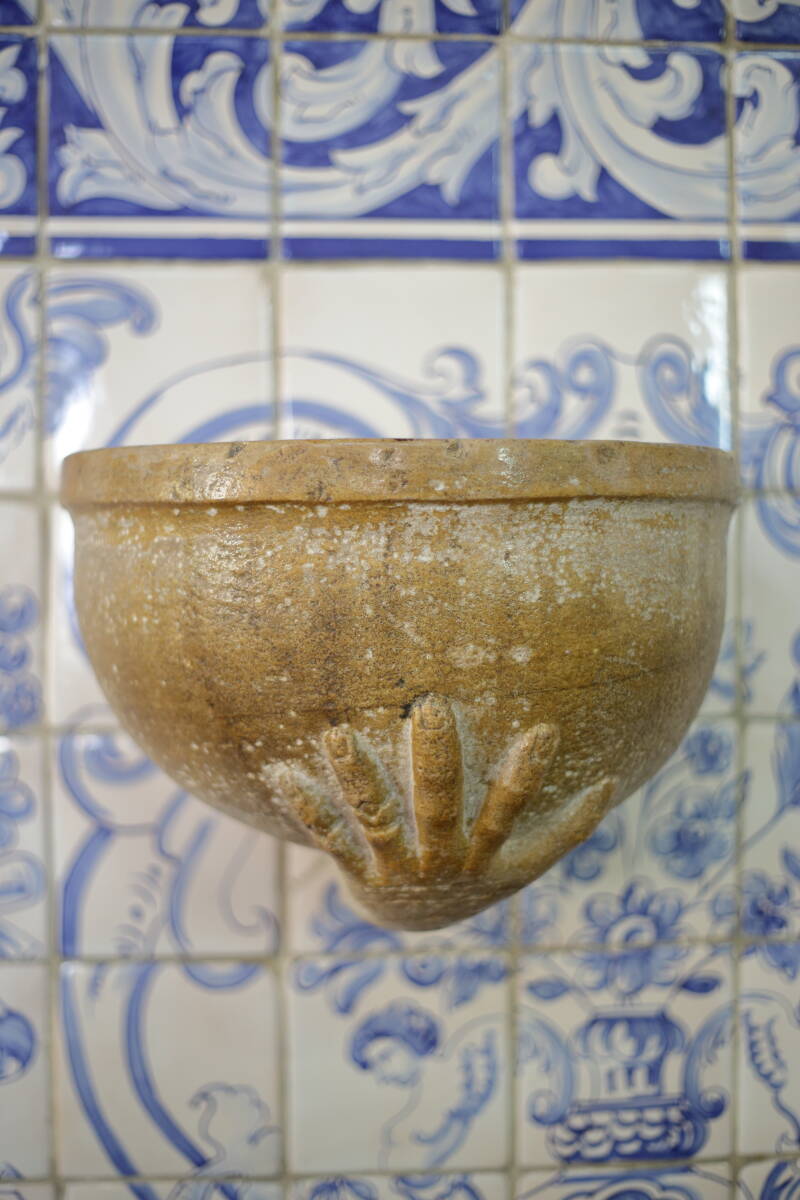
The very simple inside has a single nave and chancel. At the entrance, on the left, one can find the original baptismal font and, next to the side doors, two original holy water fonts. The walls are covered halfway up with ashlars of blue and white tiles and albarradas [compositions with vases of flowers], some of which are still original.
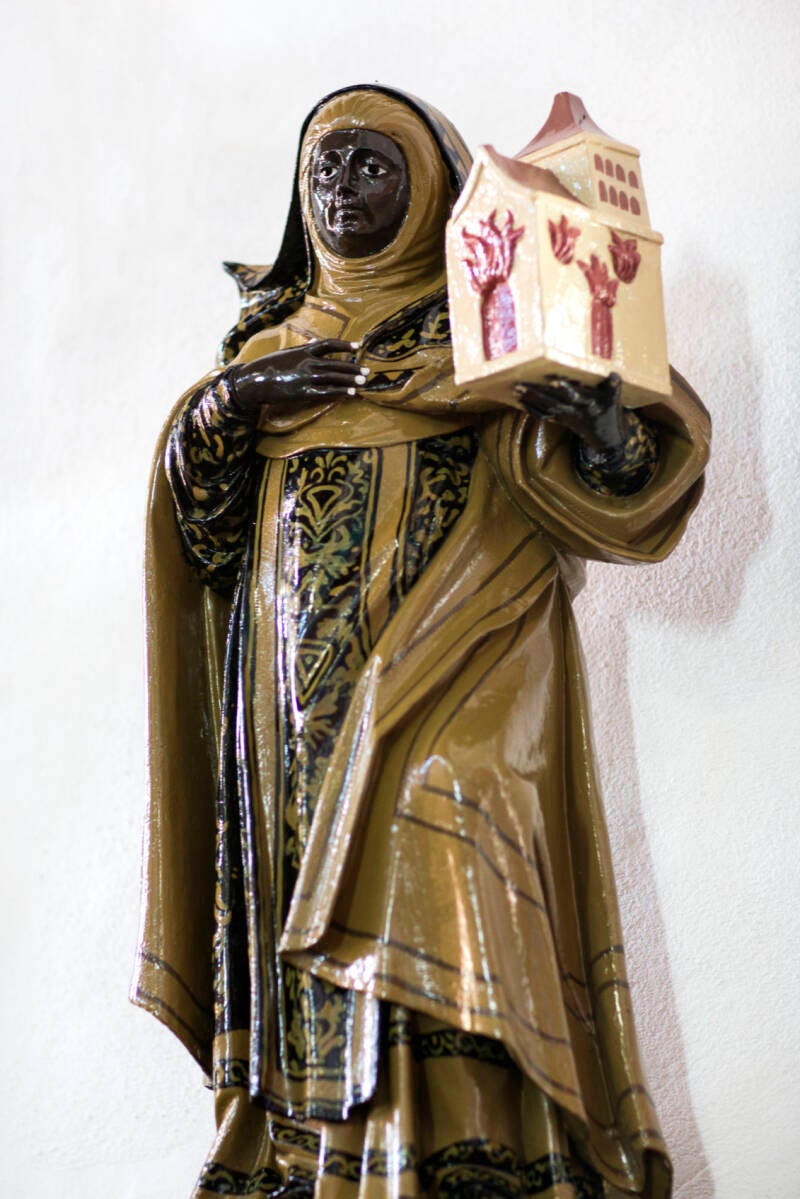
On the left-hand side there is an ancient image of Saint Iphigenia of Ethiopia, probably from the now gone chapel of Saint Iphigenia, a saint of great devotion in Africa and Brazil. Saint Iphigenia is depicted in a Carmelite habit, holding a church in flames, an allusion to the miracle of saving her convent from fire.
Also noteworthy is the pulpit, with a wooden baluster and a star – probably a Marian symbol – on the upper part of the wall.
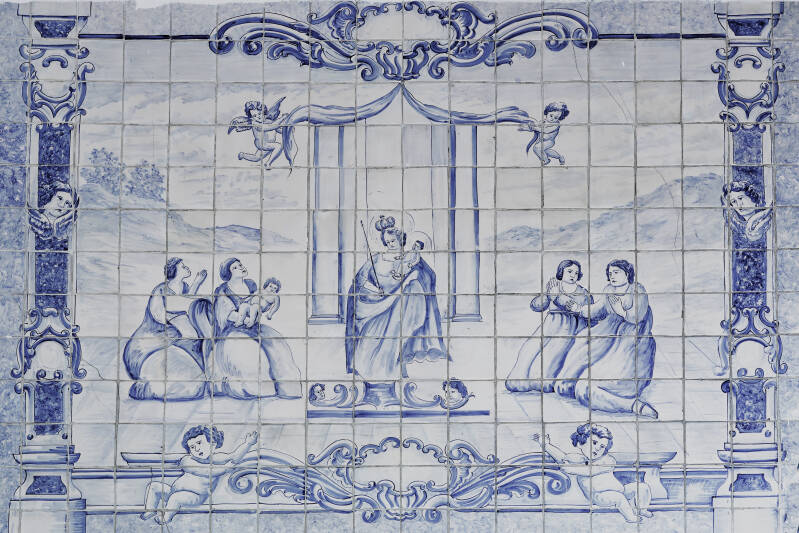
The triumphal arch is completely lined in blue and white tiles, with scenes alluding to the invocation of the church: on the right, The miracle of Our Lady of Nazareth, where Fuas Roupinho can be distinctively seen with his horse suspended over the cliff; and on the left, Our Lady enthroned surrounded by devotees. These panels were placed in 1942, replacing the old ones which were badly damaged.
The two side altarpieces are dedicated to Our Lady of Fatima and the Sacred Heart of Jesus. They feature twisted columns and decorative elements in gilded woodcarving.
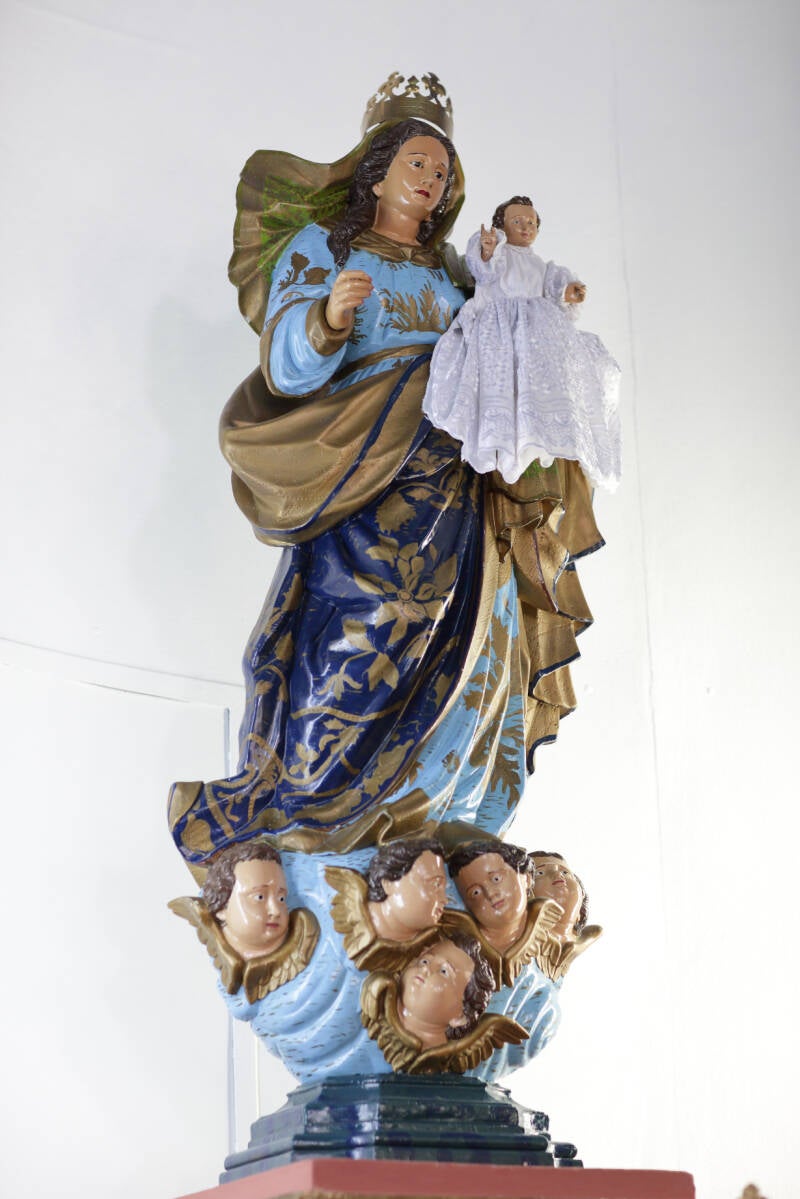
In the chancel, the Patroness presides as an original and restored image. The altarpiece, also the restored original, includes three pairs of twisted columns. The walls are completely lined with tile panels alluding to the miracles of Our Lady of Nazareth, all restored in the 1970s.
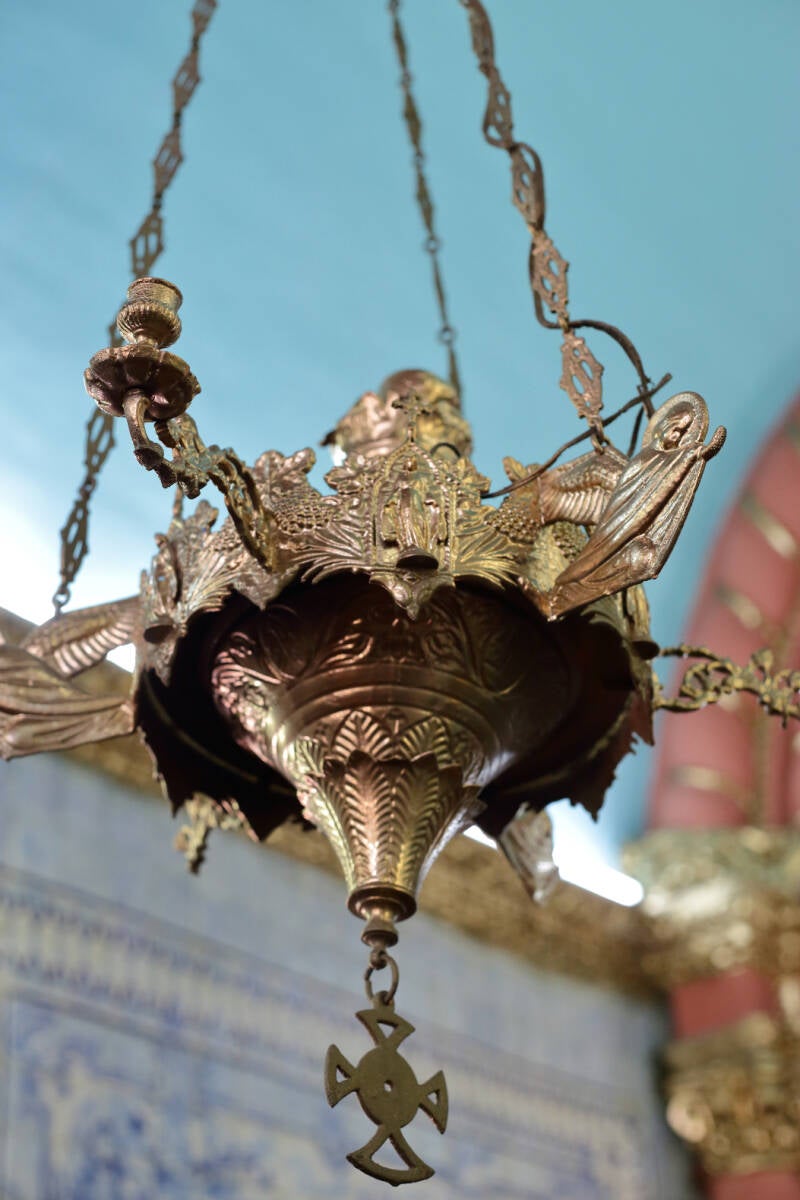
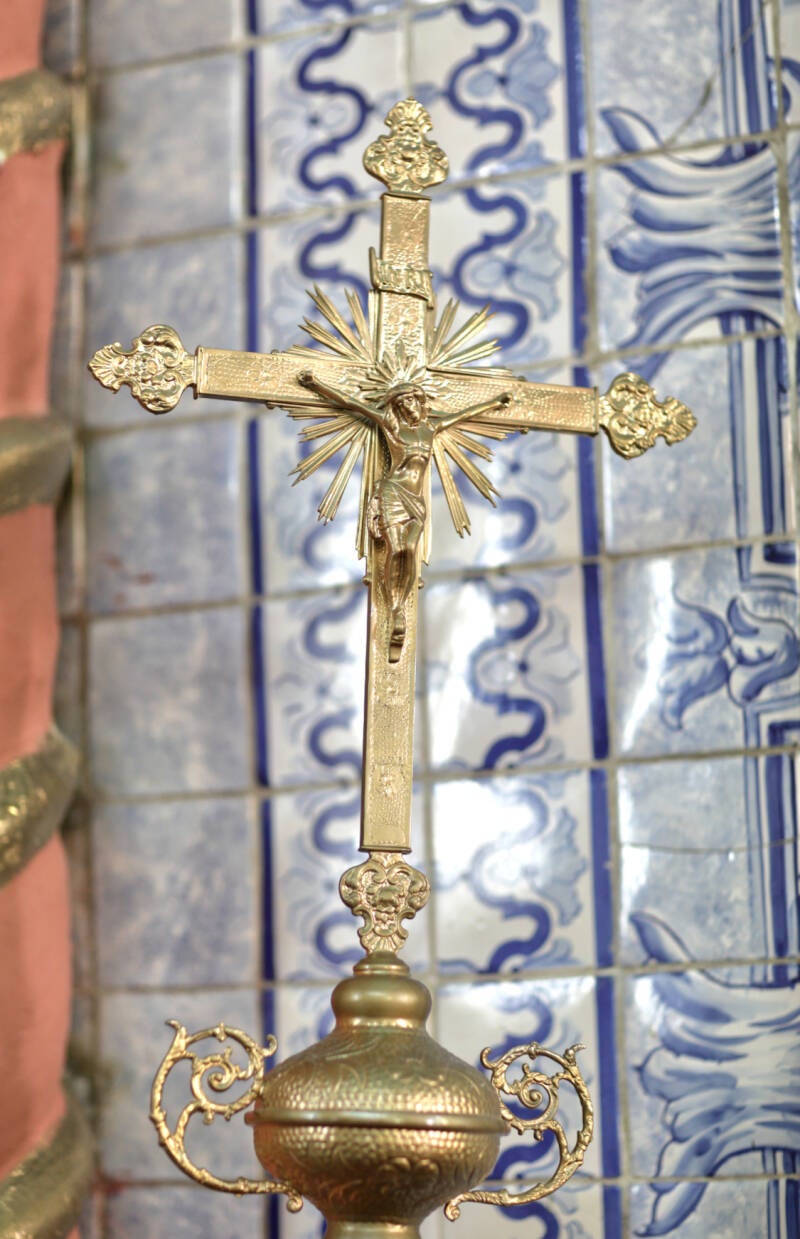
Other highlights are the big chandelier and the processional cross.
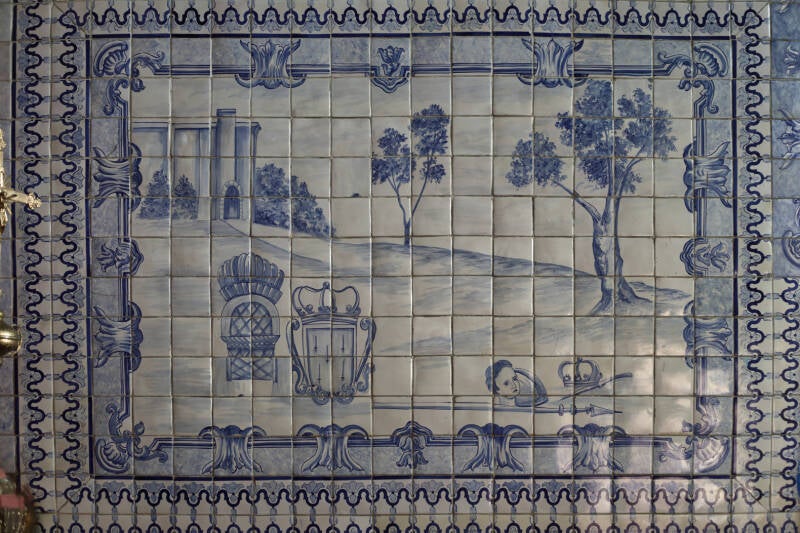
According to contemporary accounts, the head of the King of Congo, D. António I, is buried in the chancel.
III . THE TILE PANELS IN THE CHANCEL
The panels currently in the church's chancel are copies, probably made during the restorations in the 1970s. They are a much-simplified version of the originals. The extraordinary baroque framing, as well as some important details, particularly of the famous battle of Ambuíla, are now gone.
At the entrance of the chancel are two tile panels alluding to miracles attributed to the powerful intercession of Our Lady of Nazareth, thought to be the reason behind the building of this chapel: on the left, Invocation to the Virgin of Nazareth and, on the right, the Miracle of the shipwreck.
The two large side panels, of great iconographic and documentary value, were made after the Battle of Ambuíla. In the panel of the Battle of Ambuíla, the general view of the battle presents the square of the Portuguese and Angolan forces in folded ranks in the centre, surrounded by the large Congolese army. Both forces, who, according to historical sources, were made up mostly of African warriors, display flags and banners. In the top right-hand corner is the image of Our Lady of Nazareth, believed to have favoured victory.
On the panel of the Insignia of the King of Congo, also depicted in a very simplified way, the following stand out: the head of the King of Congo D. António I, killed during the battle of Ambuíla, and solemnly buried here with all the honours due to a valourous adversary; the throne; the coat of arms with five [arms armed with] swords, in the shape of an X; the crown; and the royal spear.
IV . OUR LADY OF NAZARETH: CULT AND ICONOGRAPHY
The invocation of Our Lady of Nazareth originated in Portugal. According to tradition, in the 4th century, a small image of the Virgin was taken from Nazareth in Galilee to Bethlehem, then to Northern Africa and finally to the west of the Iberian Peninsula. Here, it was hidden in a recess in the rock near the present-day Sítio da Nazaré, until it was discovered in 1182. Grateful for having been saved from falling from a cliff while chasing a deer, the Mayor Fuas Roupinho, ordered on that date that a chapel was built dedicated to Our Lady of Nazareth. The church of the sanctuary was built later on, with porches intended for the pilgrims.
The worship spread all over the world during the time of the Portuguese discoveries, with the Lady of Nazareth often invoked in dangerous situations at sea. In Angola, the cult was introduced by Governor Vidal de Negreiros.
The Sanctuary of Our Lady of Nazareth in Luanda quickly became a centre of pilgrimage and Marian devotion, and since then there has been no end to the news of graces granted through the powerful intercession of the Mother of God.
Iconographically, Our Lady of Nazareth is represented with a crown and with the Child on her lap. The liturgical feast takes place on September 8th and includes the traditional candlelight procession.
REFERENCES
- CUNHA, Mons. Alves da, Ermida de Nossa Senhora da Nazaré, O APOSTOLADO, ano XV, nº 768, de 28-10-1950.
- BATALHA, Fernando, A Ermida de Nossa Senhora da Nazaré, O Turismo, Luanda, 1968, ano 1, nº 2.
- MACHADO, Mª Antónia Graça Saavedra, MACHADO, João L. Saavedra, Nossa Senhora da Nazaré na Iconografia Mariana, Museu da Nazaré, 1982.
- MATTOSO, José (dir.) - Património de Origem Portuguesa no Mundo, arquitectura e urbanismo: África, Mar Vermelho e Golfo Pérsico. Lisboa: Fundação Calouste Gulbenkian, 2010.
PHOTOGRAPHY
- ACDA – Associação para a Cultura e Desenvolvimento de Angola
Adicionar comentário
Comentários